In Lesson Five of this series of Long and Short Stitch Shading Lessons, we're looking at element 4 on the sampler, the ribbon-like swirl and the little swash shape in the top right corner.
If you are just joining us for these lessons in shading with long and short stitch, you can find all the articles related to the lessons listed under the Long and Short Stitch Lesson Index. For those of you who want to know what these lessons are all about, they are merely to help the embroiderer learn the basics of long and short stitch shading in order to feel confident in tackling more complex needle painting projects. The lessons are free and will be kept here on Needle 'n Thread, easily accessible, so that you can follow them at your own pace.
The fifth long and short stitch lesson focuses on stitching around a curve, in order to shade design elements such as ribbon or flowing text.
For this element (the top right corner of the sampler), you will need the same shades of blue that were used on the triangle: DMC 159, 159, 160, and 161.
You'll also need #9 or #10 crewel needles, sharp embroidery scissors, and a hoop or frame to keep the work taut.
For basic technique in long and short stitch, feel free to visit Lesson Two, where you will find three videos demonstrating basic long and short stitch. Reading and working through the previous lessons up to this point will help you as well.
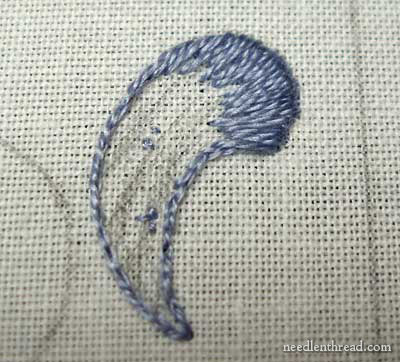
Begin with the small swash next to the ribbon. Anchor your thread and split stitch an outline around the small swash in medium-light blue (160). Begin the long and short stitch (in 160) in the center of the rounded end of the swash, working to the right side of the swash, then going back to the center and working to the left edge of the swash.
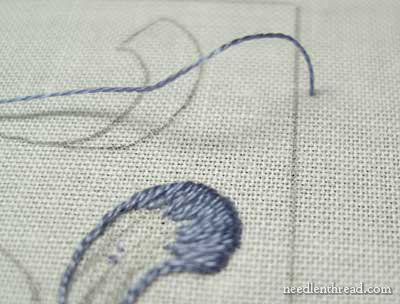
When you finish with color 160, if you still have "stitching room" on your thread, take your needle from the back of the fabric to the front, outside to the working area, without cutting the thread. You can leave your thread here until you are ready to use this color again. This way, you don't have to end and re-start the thread each time you need to use the same color.
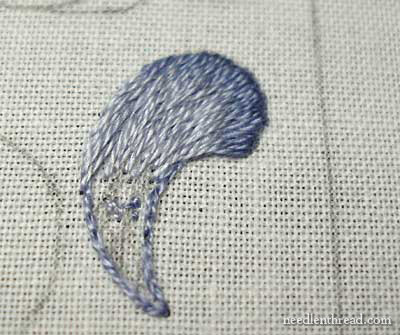
Switch to light blue (159) and stitch two ore more rows of long and short stitch, to fill the main central part of the swash. As you stitch each row, make slight adjustments in direction in order to ease your way aroudn the turn of the swash. See the phot below for stitching direction:
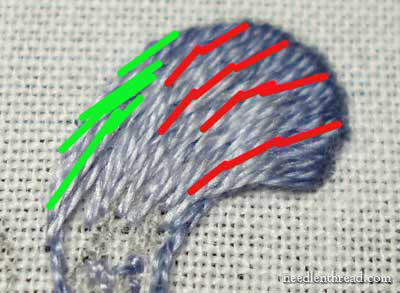
The red slashes indicate the turning stitches. The green slashes indicate the stitches that extend to the side and over the split stitch outline. As the stitches on the left approach the split stitch line, take them over the line to ensure a smooth edge. Keep gradually moving your stitches around the bend of the swahs, adjust the stitch direction as you grow. Switch back to medium light blue (160) for one row, then medium-dark blue (161) for the next row, and then end the swash at the point in dark blue (158).
The key in getting around the curves gently is to slowly adapt your stitches to the curve. Take small stitches where need be (in fact, your stitches will be smaller going around the curve), in order to "tweak" the stitch direction so that your stitches are working in the direction you want them to go (which is toward the tip of the swash). Remember that, as your space gets smaller, you use fewer stitches (just as you did with the triangles).
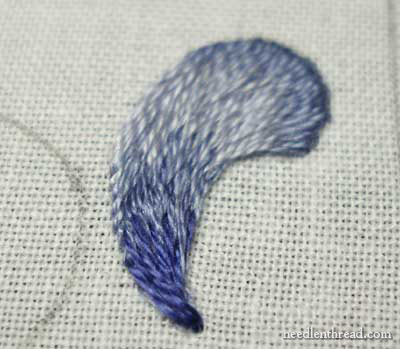
When you finish your swash, it should look something like this.
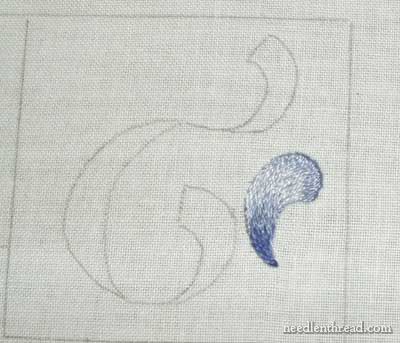
(Mine looks better from farther away!)
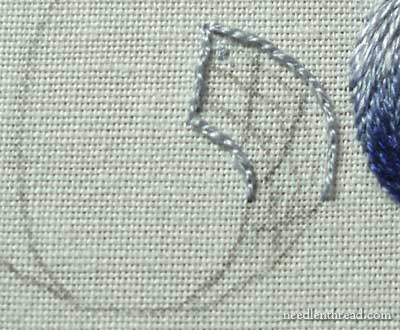
Once you've finished the small swash, you're ready to move on to the large ribbon shape. Begin on the lower right tail of the ribbon. Outline in split stitch (159) as demonstrated in the photo above. You do not need to outline the whole shape - just the top edge of the ribbon and about half way down the sides.
Use a pencil to mark direction lines down the length of the ribbon tail, and color-change lines across the width of the ribbon tail, as shown in the photo above. You want four sections of the area "blocked off" to mark approximately where you will change shades.
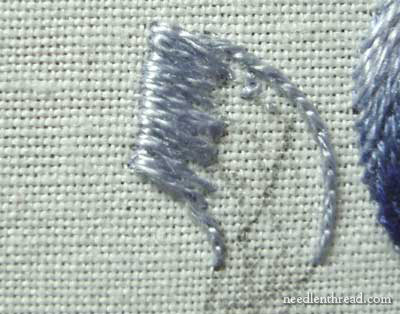
Working in light blue (159), work the long and short stitch over the split stitch line at the top end of the ribbon.
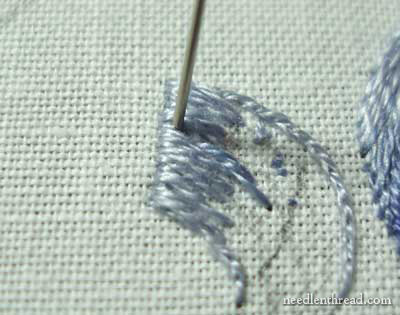
Begin the next row of long and short stitch in medium-light blue (160). Remember to take your new stitches deep into the first row of stitches.
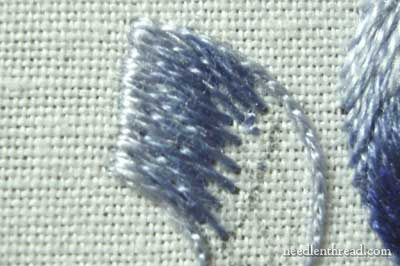
Work the third row of stitches in medium-dark blue (161). Begin shifting your stitch direction more dramatically in order to accommodate the curve.
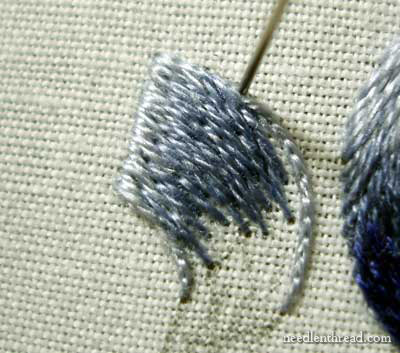
When it becomes necessary to cover the split stitch line, bring your needle up outside the line so that you can cover it. You'll take the stitch back down inside the shape.
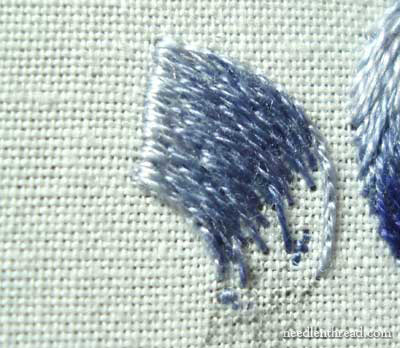
You'll probably work at least two rows in medium-dark blue (161). These rows will require the most dramatic change in stitch direction. Try to follow the curve of the ribbon, using relatively short stitches and adjusting their direction as you work around the curve.
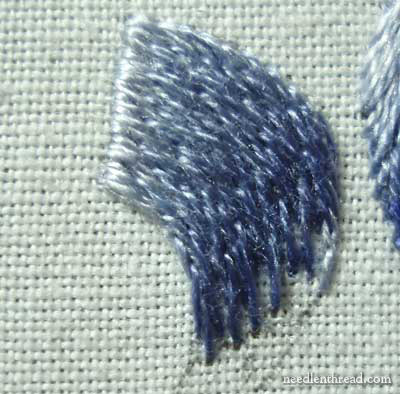
Finally, switch to the darkest blue (158), and continue working in short stitches, easing around the curve to the point of the ribbon curl, and decreasing the number of stitches in order to fit the design area.
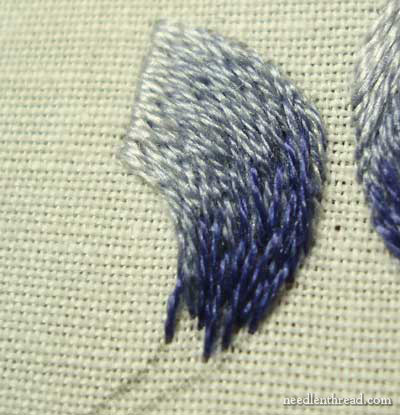
Continue to add subsequent rows of dark blue (158) until you reach the tip, as shown below:
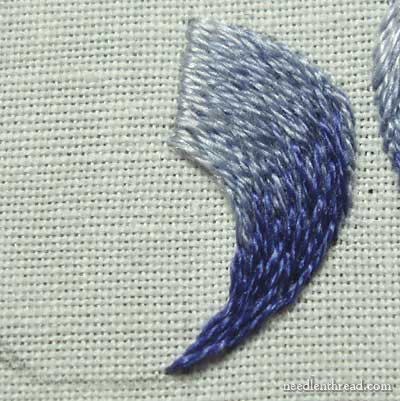
This is the finished first ribbon tail.
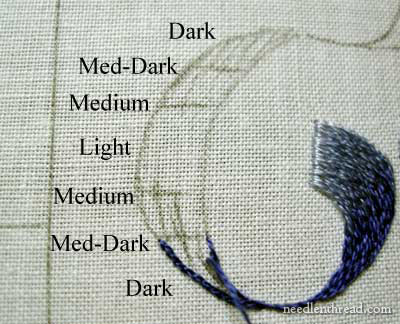
At this point, you can mark in your stitch direction lines and your color lines on the main section of the ribbon. Divide the ribbon across its width as indicated above. In the widest part of the ribbon here, the center will be light, and it will gradually get darker towards the tips. The stitch direction will work around the curve of the ribbon.
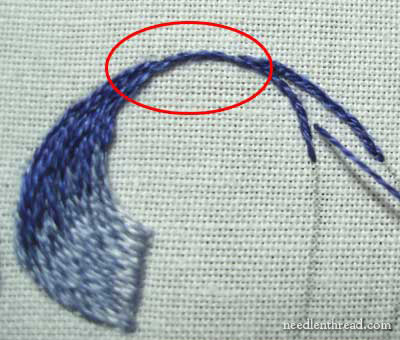
Now that you've finished the lower tail of the ribbon and marked your stitch direction, turn your work over so that the element is upside-down. The next section of the ribbon is easier to work upside-down. First, using 158 (dark blue), stem stitch the thin line between the curl you just finished and the main section of the ribbon. (The area circled in red in the photo above). When your stem stitch reaches the point where the lines divdide to form the mid-section of the ribbon, you can switch to split stitch for outlining the area. Outline on a little way up into the main curve of the ribbon (also shown in the photo above).
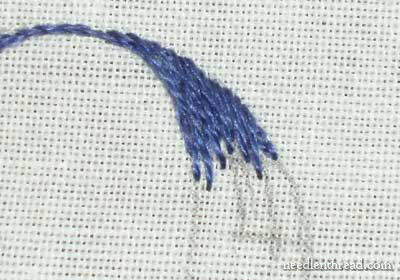
Then, in the darkest blue (still 158), work long and short stitches to fill the tip of the ribbon, working from the narrow point to the wider center.
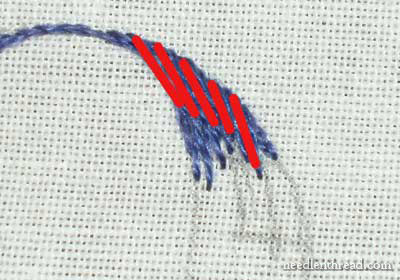
The red lines above indicate the stitch direction. Notice that I'm not starting in the tip of the ribbon, and fanning out. Rather, I'm starting on the side of the ribbon, and working almost vertically.
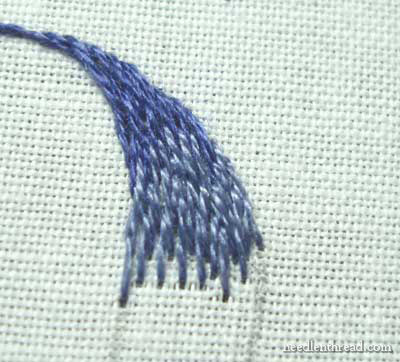
Switch to the medium-blue (161) and then medium blue (160) and continue to work long and short stitch to fill the riboon shape.
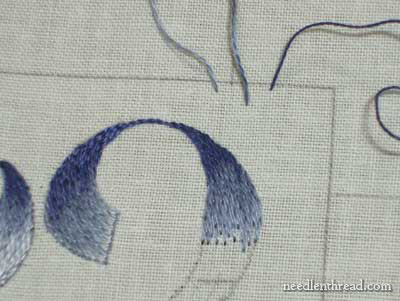
As you switch colors, anchor your working threads in the fabric above the design so that you can keep using them when you return to those colors on the rest of this section.
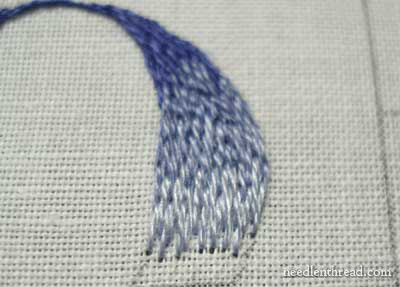
In the widest part of the ribbon (center), switch to light blue (159), and stitch two or three rows (depending on the size of your stitches). Alter the direction of your stitches to gradually move them towards the tip where the lines of the design converge.
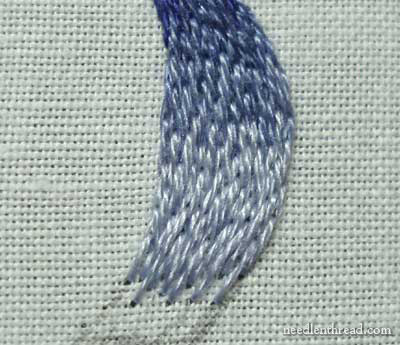
Keep adjusting your stitches as you round the curve, and then switch back to medium blue (160).
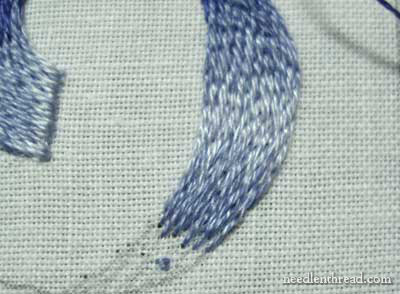
After stitching a row of medium blue, switch to medium dark (161) and continue towards the tip of the ribbon.
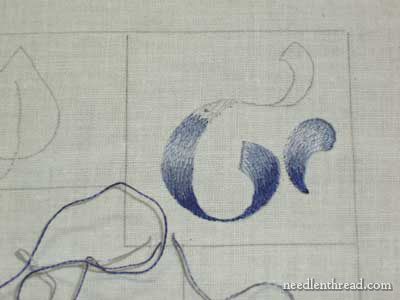
If you turn your work right-side-up at this point, it should basically look like this. You can outline the tip in split stitch, using dark blue (158) if you wish. I did not outline at this point - I just continued filling to the tip where the lines of the design converge.
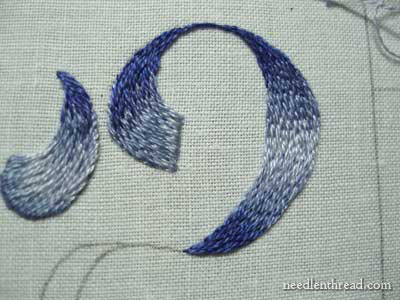
Working upside-down again, continue filling with the darkest blue, to the tip of the large ribbon curve, easing your stitches around the curve by changing their direction little by little.
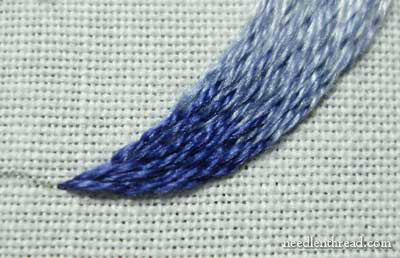
The tip should look like this.
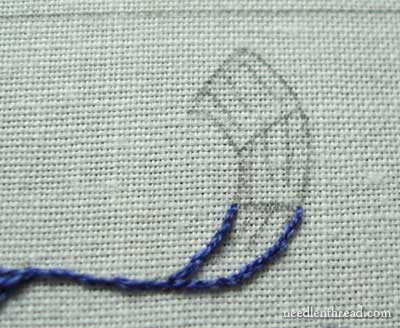
Continuing with the dark blue (158), stem stitch the line between the main part of the ribbon and the top curl. Again, where the lines separate to form the top curl of the ribbon, switch to split stitch and outline the lower third of the curl.
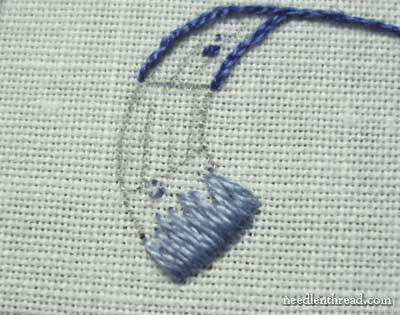
Mark in your stitch direction lines and the lines to indicate changes in shade, if you wish. Split stitch the very edge of the ribbon (hidden here by long and short stitch) in medium-light blue (160), and then work one row of medium-light (160) in long and short stitch. If it is easier for you, turn your work upside down again.
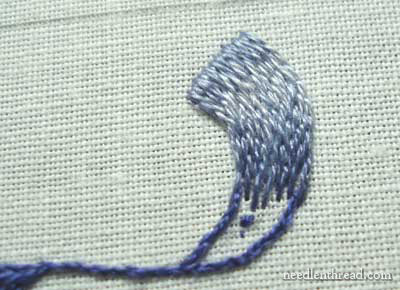
Following the same sequence as in the lower curl on the ribbon, work a row or two of light blue (159) in long and short stitch, tweaking your stitch direction as you work around the curve. Then switch to medium-light blue (160), then medium-dark blue (161) - one row of each - then to dark blue (158), which will fill the tip.
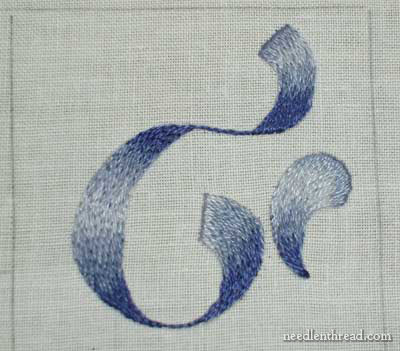
Congratulations! You have finished the fourth element in the Long and Short Stitch Shading Sampler - the most difficult element so far! If you're still with me, you'll find the next element (the center leaf on the top of the sampler) a breeze! See you in Lesson Six!
Here's a PDF download of this lesson:
Lesson Five: Long and Short Stitch Shading on Curves
For previous lessons, visit this Index of Lessons in Long and Short Stitch Shading.


|