|

|
2009-09-01 06:27:26-04 |
|
|
Castelo Branco is a city in Portugal just north of the Spanish border in central Portugal. Like many cities and regions in Europe, Castelo Branco has its own unique style of embroidery. Méri recently introduced me to this type of needlework when she sent me a beautiful magazine dedicated to the embroidery of Castelo Branco and featuring many gorgeous projects. Take a look!
The embroidery of Castelo Branco brings one word to mind - it is rich. It is rich in color, design, and symbolism.
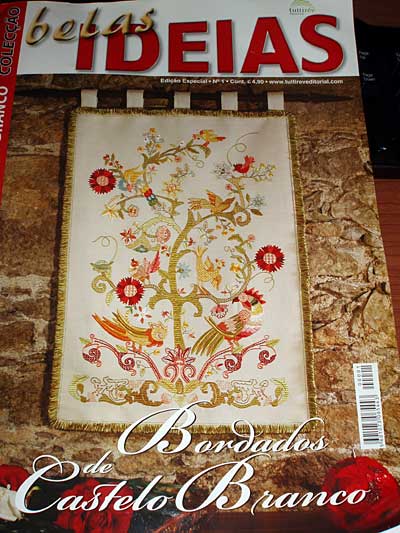
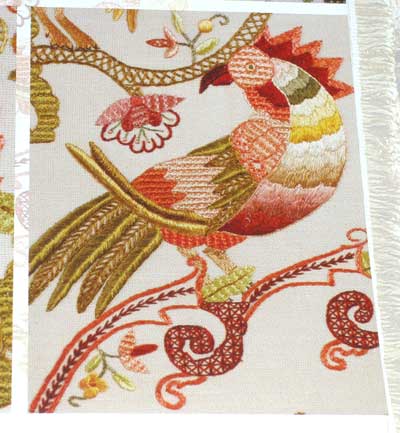
This traditional Portuguese embroidery is worked on a linen ground, traditionally with silk threads. The predominant filling technique used is Ponto Castelo Branco, or Ponto Frouxo - long satin stitches with a perpendicular thread couched over the satin stitching to secure it. The technique reminds me very much of Italian stitching, which is comprised of long silk satin stitches couched over with gold passing thread (I used this technique for the sky in my Agnus Dei project). The obvious difference is the type of thread used for couching.
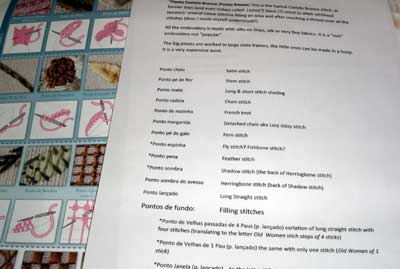
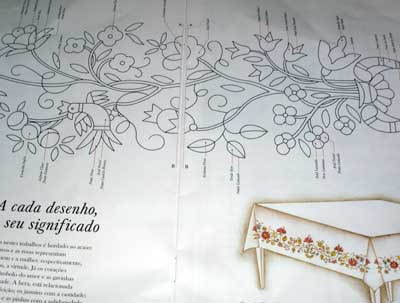
Among the other stitches used in the embroidery of Castelo Branco, you'll find satin stitch, stem stitch, long and short stitch shading, chain stitch, French knot, detached chain stitch, fern stitch, fly and feather stitch, shadow stitch, herringbone stitch, straight stitch, and various fillings. Méri was very kind to translate the stitches for me! The magazine, Belas Ideias, published by tuttirév, includes not only an abundance of designs but also a pictorial stitch dictionary.
The embroidery is by no means "popular" or common embroidery - it was worked, in its day, for those who could afford to pay for it.
It seems the most wide-spread application was in decorating bed coverings, which were often part of the trousseau or dowry of a young bride. Today, the embroidery of Castelo Branco can still be purchased or commissioned, with prices ranging all the way up to 45,000 Euros for a bedspread, depending on size and design.
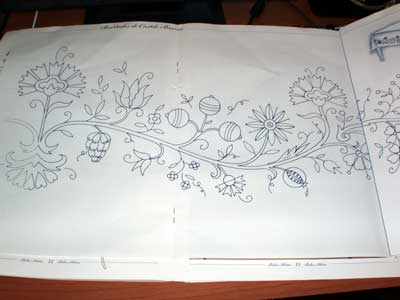
Have you noticed that the designs are somewhat reminiscent of Jacobean embroidery? The tree of life is a common image, as are fanciful birds, animals, flowers, vines and tendrils, and fruit.
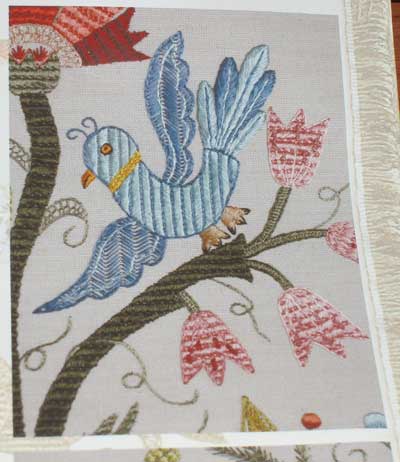
The elements included range from the sacred to the profane, and many of them have symbolic meaning.
I think this embroidery style is lovely! While it is like Jacobean in some respects, in other respects it is quite unique - the abundance of couched-over satin stitching is defintely different, and the threads used are a flat, lightly twisted silk (originally, a filament silk - today, artificial silks are also widely used).
The designs in the magazine are calling my name!! (They're practically screaming, actually!) Méri often teases me for introducing her to embroidery she "must" try (like the Schwalm project!), but I think she has avenged herself! I've added this to my perpetually growing List of Things to Do, and I'm already looking ahead for my next block of time, where I can set up a small project. There's an ideal "little" project in the magazine, which would make a perfect Christmas gift.
Thank you SO much, Méri, for introducing me to the embroidery of Castelo Branco! The book is beautiful! Thanks, as well, for the linens and threads! I will make use them all soon and keep you posted on how it goes!


|
|
|
|
|
