Colbert embroidery is an embroidery technique that combines surface embroidery stitches and counted work in one piece of needlework. It apparently developed in the 19th century, to mimic the embroidered laces (such as Dresden lace) of the century before. It is not so fine as Dresden lace, though - in fact, Colbert embroidery tends to look rather bold and coarse next to the delicate whitework of Dresden lace. And, to boot, Colbert embroidery is usually worked in color.
Colbert embroidery reminds me a lot of the free-form blackwork of the 17th century. Like blackwork from this early era (and unlike most blackwork today), Colbert embroidery is typified by bold lines that make up the predominant design of the piece, while the backgrounds are filled with geometric filling patterns.
Colbert embroidery is not too well-known today - look it up online, and you'll find only a few resources available, some of which have simplified the look of the technique quite a bit. In fact, in its heyday, the technique was quite elaborate and intricate, as can be seen from the samples that are featured in Therese Dillmont's Complete Encyclopedia of Needlework.
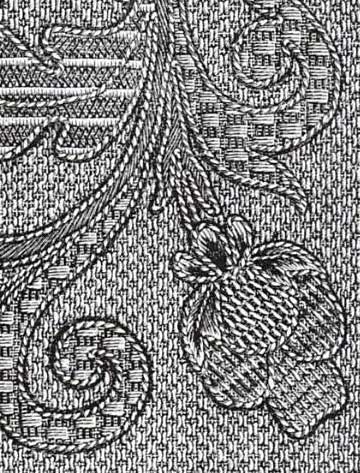
The photos in Dillmont's book are black and white, of course, but you can see clearly that Colbert embroidery was a rather "busy" technique. The flowing lines and shapes of flowers, leaves, and so forth were formed by surface stitches or couched braid. Then, within the shapes and over the background fabric, various counted fillings were worked. The technique was used to decorate pillows, mats, and so forth.
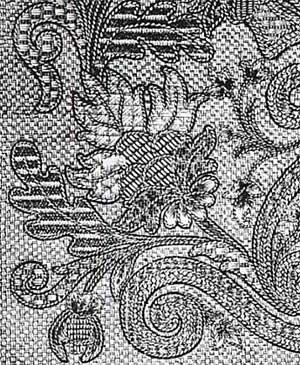
The structured, counted filling patterns contrast quite vividly with the flowing lines and curves of the designs. According to Dillmont, Colbert embroidery involves "large designs worked on coarse, transparent material with various filling stitches and braid outlines... The foundation is soft (washed) congress canvas..." and the threads used were actually quite a variety, from cording to stranded and pearl cotton to silk.
Today, Colbert embroidery still exists, and there are even books about the technique, though they aren't very common. Through The Mad Samplar, I picked up one book on the technique at the online needlework retail show that ran last week.
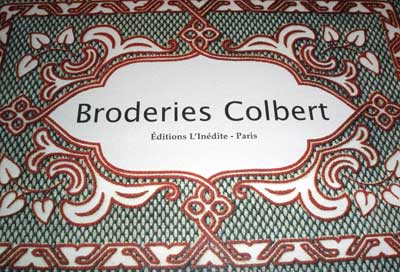
You can see from the cover of the book that the technique has been somewhat simplified. It's quite bold and grand, isn't it?
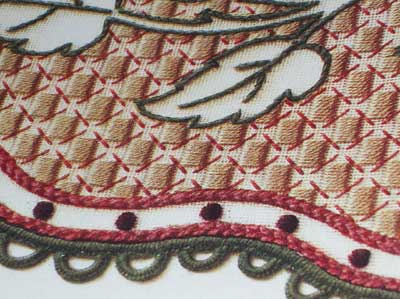
However, though somewhat simplified compared to the samples in Dillmont, it still reflects the combination of surface stitches in bold designs and geometric background fillings. In the book above, Broderies Colbert, the actual design area is left voided, which makes it somewhat similar to Assisi work.
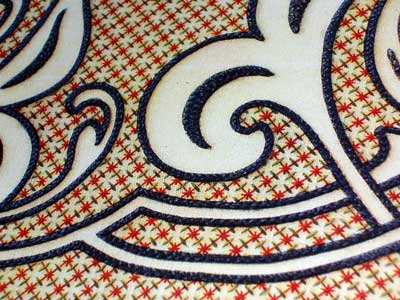
The voiding of the bold designs is effective, I think. It creates such a stark contrast with the background.
While the book does not go into stitch directions (at all), it does give close up images of different background techniques, which would be a cinch to imitate. The text is in French, dedicated pretty much just to materials lists for the various projects featured in the book - so knowledge of the language isn't entirely necessary, as most of the supplies are pretty straightforward.
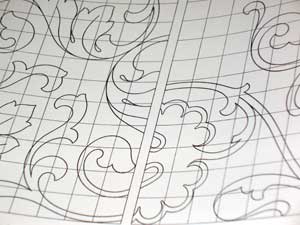
In the back of the book are small line patterns that are suitable for enlargement.
When I saw this technique and started reading a bit about it, I made an immediate connection between it and the book Wessex Stitchery, which I've already reviewed.
Wessex Stitchery focuses on a variety of filling techniques - some, admittedly, are probably too busy for Colbert embroidery. But others would serve the technique well, I think.
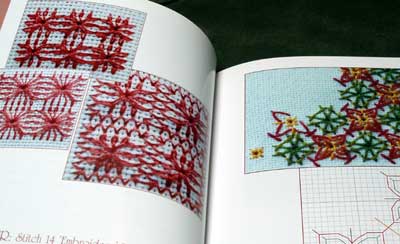
The photo above is from Wessex Stitchery - and the filling pattern featured there would work for Colbert embroidery, too, I think. The idea of combining Colbert embroidery with Wessex stitchery presents some interesting possibilities.
Colbert embroidery is worked today on Congress cloth, Jobelan or Etamin fabrics - all of which are cotton or blends and resemble canvas more than they resemble fabric. And this means that, in the areas that aren't stitched, you can see through to whatever is behind the fabric.
I am wondering how the technique would work on linen; perhaps the weave would have to be looser to accommodate some of the thicker background motifs. I'm also wondering how the technique would work for, say, a monogram, if the monogram were voided (that is, empty of stitching), but outlined with a surface stitch, and then the background were filled with some of the intricate fillings in the Wessex Stitchery book. A good pillow for a gift? A Christmas stocking? Oh, the possibilities...
And isn't this just the Greatest Thing about embroidery? When it comes to designing or to combining techniques, we really are only limited by our imaginations!
Have you ever tried Colbert embroidery? Do you know of any additional, thorough resources on the technique that you'd like to share with the rest of us? Does this technique appeal to you at all - or do you see any possibilities for combinations or for projects? What are YOUR thoughts?
Thanks for putting up with my ramblings! Have a terrific weekend!
|