|

|
2010-01-02 10:58:22.571-05 |
|
|
I'm on a crewel kick, if you hadn't noticed (and the crewel puns are probably getting pretty old!) But as life would have it, one interruption after another has prevented me from setting up the Crewel Rooster. I suppose I could be really unsociable and mean and lock all the doors and put a "Go Away" sign out - but that would hardly be very holiday-spirited, now, would it? (Forgive me a crewel chuckle... while I go post the sign....)
Recent e-mails and comments on previous posts have raised a few questions that I want to address here, and I also want to show you how I set up these little crewel "smalls" that I've been working on lately. They've turned out to be great little embroidery projects that are quick to work.
We'll start with setting up a crewel embroidery project on a stretcher bar frame. Now, what I'm doing here really holds true for practically any embroidery project set up on stretcher bars. I'll try to elaborate as I go along and explain any differences.
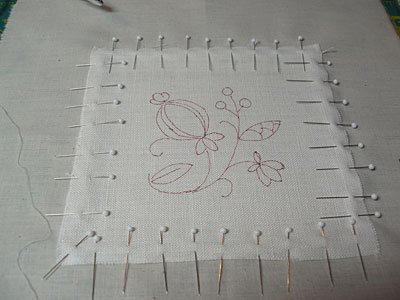
What you see here is one of the smalls from Tristan Brooks Designs. I wrote about Tristan Brooks Designs at length recently, so I won't go into explaining what these are - you can read about them on the previous post. But what you want to note here is that the ground fabric for the crewel work in these little kits is actually a regular weave linen. That is, the threads that form the fabric are horizontal and vertical threads, perpendicular to each other. I believe it's Strathaven linen that comes in the kits, and it's a nice, solid plain-weave linen.
The linen requires a lining fabric behind it, to support the stitches used in crewel work and the weight of the thread. When you're cross-stitching with linen, you wouldn't put a lining fabric behind it. After all, you're working in holes naturally formed by the intersections of the threads in the fabric. But with surface embroidery, the stitches don't necessarily conform to the holes in the fabric, and so you end up splitting the linen threads as you stitch, and stitching in the holes. A lining fabric helps you maintain smooth edges and curves. So, behind the linen here is a piece of regular cotton muslin (aka calico).
The point of this is to let you know that, although I will definitely be working on linen twill in my upcoming rooster project (more on the subject of linen twill later!), crewel embroidery can be done on a plain-weave linen. Just make sure you line it with a piece of muslin.
What you see in the photo above is the muslin in the background, with the linen placed over it. The grain of the linen and the grain of the muslin need to match! Make sure you line up your lining fabric when lining any piece of embroidery with the grain of the ground fabric. If one of the fabrics is off - if the fabric grains don't match - you risk your embroidery puckering. Actually, it's not just a risk - it's definite! Imagine having your linen "square" - the grain of the fabric running perfectly horizontal and vertical on your work table - but putting behind it a piece of muslin on the bias. The muslin will be stretchy, because it's turned on the bias! This will create puckers.
So line up your two fabrics on the grain, and pin them all the way around.
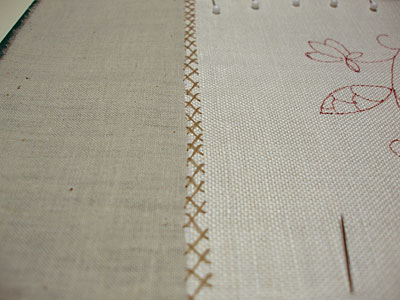
Double up some sewing thread, and stitch your linen ground fabric to the muslin lining, using a herringbone stitch.
Now, a little bit about this: on these little projects that I'm working on here, a close running stitch around the inside of the linen (though the linen and the muslin) will work fine. And it's a lot faster than working a herringbone stitch. But if you're working a bigger project that will be framed up for a while, stick with the herringbone stitch!
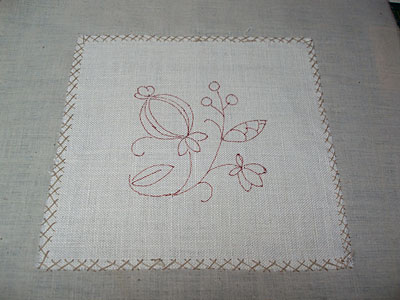
Once you've stitched all around the edges of the linen, you're good to go.
It works out well for me that the muslin is much larger than the linen square, because I don't have a frame small enough to accommodate just the linen. If you're working on a larger frame than the size of your ground fabric, make sure you cut your muslin large enough to fit your frame. In these circumstances, you'd actually be pinning the muslin to stretcher bar frames, rather than the linen.
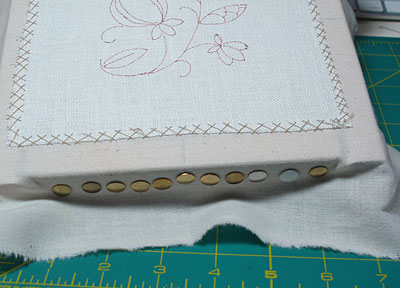
For crewel work, your fabric must be drum tight. You have three options for achieving this: a hoop, a stretcher bar frame, or a slate frame.
If you don't have the latter two options available, then use a hoop. I have my druthers about hoops! Previously, I've presented an argument for good embroidery hoops, and I've also talked about binding an embroidery hoop. You might want to read both of those articles, if the question of hoops is confusing to you. At the same time, though, if you're just starting out and you don't want to invest yet in supplies, and you have a regular "Susan Bates" plastic hoop that you use, by all means, use it. Just don't leave your fabric in it when you aren't stitching! They are more prone to catch dirt than other types of hoops, because of the little "lip" on the inside ring.
Stretcher bars are sold at specialty needlework shops. You can find them as well at Michael's in the needlework aisle, but the ones sold there are made of a hard wood and are unfinished, so it's difficult to push the tacks in them, and they're splintery, which is never quite comfy on the hands. The stretcher bars that I love to use - and I don't use any others anymore - are Evertite stretcher bars. This is also a topic I've already discussed here on Needle 'n Thread, so you might want to read my previous review of these stretcher bars if you don't know anything about them. I just love them! I've slowly invested in practically every size, and I use them All The Time. (I should have stock in that company - I plug them a lot, too... but we aren't affiliated!)
Slate frames are a little more complicated and a little harder to come by, but not as impossible to come by as they were three or four years ago! I use a slate frame (I have two, a medium and a large size) for larger pieces that will be set up for a long time. It is true that slate frames are the best when it comes to providing consistent, drum-tight, adjustable tension for your embroidery projects. But they are sometimes a pain to set up (you can see my previous tutorial on dressing a slate frame), and for smaller projects, I find the Evertite stretcher bars a better choice all around. But if you're keen on using a slate frame, then you'll find them available through Hedgehog Handworks and through Tristan Brooks.
All that having been said, the 8" Evertite stretcher bars work perfectly for these crewel smalls, and I'll be using a set of 10" Evertite stretcher bars for the rooster.
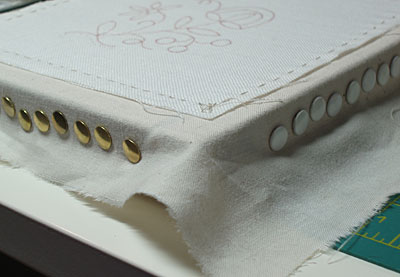
The review of the Evertite frame is really more of a tutorial on how to set one up, so if you don't know how to set up stretcher bar frames, you might want to take a look at that article, too.
Now, if the house is quiet today - if no company stops in - then I'm setting up that rooster! Keep your fingers crossed for me!
(Actually, really - what would life be without friends and family stopping in?! I'll get the rooster set up eventually!)
More on crewel work later, with a bit of information on threads and so forth. Crewel work, by the way, is really just surface embroidery worked (normally) in wool threads. You don't have to limit yourself to wools, and if you want to join along and try out a bunch of stitches typical of crewel work but you don't have wool, don't worry about it! Use what you have on hand!
Enjoy the weekend, everyone!!
|
|
|
|
|
