I'll tell you a secret. I'm nuts about the 16th - 17th century embroidered boxes (or caskets), and I've always had this deep-down-secret desire to make one. I toy with the idea in my head, when I should be thinking about other things. I contemplate acting on the idea. And then... I never do. If I could do as they did Back in The Day, and send my pieces of embroidery off to the cabinet maker to have him construct a box around it, I suppose the whole idea would be more feasible. Or if someone could come up with a design or a plan for the actual box and I could do the rest, maybe that would work. Construction has never quite been my forte, and getting my head around the construction of a casket with doors and drawers and trays inside it - well. The thought results in immediate inactivity.
As I was squizzing about online the other day, though, I came across a tutorial for an embroidered box. It isn't quite the same as the 16th century caskets, but I was thinking it might be a good start for any other embroidered box people out there who have a secret desire to make their own embroidered casket - replete with drawers, removable trays, cubby holes, etc.... This one is just a simple box - four sides and a lid. A good starting place for embroidered box construction, methinks.
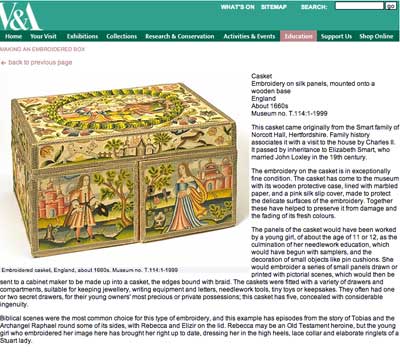
This lesson for making an embroidered box can be found on the V&A website. The lesson is meant to supplement a textile course with museum research, so it's kind of a neat idea, if you happen to live in the vicinity of a museum with a decent textile display. If you don't, though, and if you just want the nitty-gritty of the construction process, take a look at the PDF that explains how the box goes together.
If you'd like to browse the collections at the V&A for embroidered boxes, you'll want to visit their search page, and type in "Embroidered Caskets" or something to that effect.
What will amaze you is reading the descriptions of some of these embroidered boxes. The box featured in the screen shot above is described thus:
The panels of the casket would have been worked by a young girl, of about the age of 11 or 12, as the culmination of her needlework education, which would have begun with samplers, and the decoration of small objects like pin cushions. She would embroider a series of small panels drawn or printed with pictorial scenes, which would then be sent to a cabinet maker to be made up into a casket, the edges bound with braid. The caskets were fitted with a variety of drawers and compartments, suitable for keeping jewellery, writing equipment and letters, needlework tools, tiny toys or keepsakes. They often had one or two secret drawers, for their young owners' most precious or private possessions; this casket has five, concealed with considerable ingenuity.
If I had worked one of these at age 11 or 12, at the culmination of my needlework education, maybe I'd have this longing to make one out of my system by now!
Enjoy the links, and have a terrific (!) Monday!
|