Speaking to a friend and fellow stitcher a couple weeks ago, the subject of crewel embroidery books came up. I'm always befuddled when the titles of embroidery books and the names of needlework authors pop into the conversation. Truth is, they always sound familiar. But I suppose that's because there are only so many titles for books about embroidery, and when you get specific (for example, a book about crewel embroidery), there's a good chance the same words are going to be used in the title somehow. So, whether you're looking for Crewel Embroidery in England or The A-Z of Crewel Embroidery, or even The New Crewel - it's a safe bet that the word "crewel" is going to occupy part of the title!
So, given the proclivity for needlework book titles to all sound similar, and given my completely disorganized needlework library, it's sometimes difficult to know for sure if I have indeed seen a specific book, or worse, if I own it. When the book Crewel Embroidery in England by Joan Edwards sauntered into the conversation, I couldn't say for sure whether I was familiar with the book, whether I had actually seen the book, or whether I owned it.
As it turns out, it sounded familiar. A quick Google search revealed a photo of the cover, and my memory kicked in. Familiar? yes! I'd definitely seen it! Who could forget that big monster lion growling on the front of it? But did I own it? Hmmm.... that took a little more work. Foraging through shelves packed two deep and two high with needlework books, I discovered that I did own this gem of a book. But I hadn't yet discovered it was a gem.
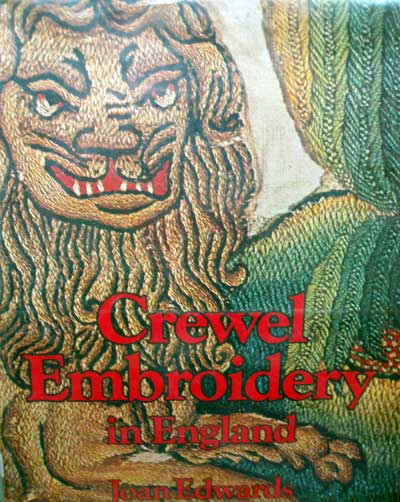
Crewel Embroidery in England by Joan Edwards was published in 1975, so if you want to read it, your best bet is to look online through used book sources or to go check your library to see if they have it available.
My copy is, sadly, a library reject. While I love getting books for a great price (I paid $1.50 for this one), it's kind of sad to know that the book isn't available in that particular library for anyone who might want to use it. The fact that it was at a library book sale demonstrates that it had lost popularity with patrons. *Sigh* If they only knew what they were missing!
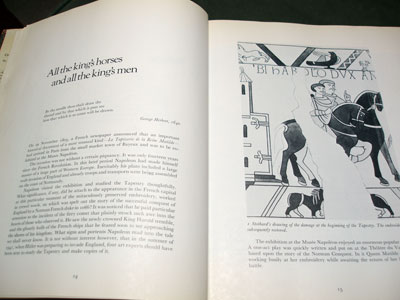
The author begins with the history of crewel embroidery in England, starting with the famous Bayeux Tapestry. Crewel embroidery, you see, was around a lot earlier than that style of embroidery which we call "Jacobean," which came into fashion under James I of England, in the 17th century. "Jacobean" comes from the Latin name Jacobus, which is James in English. Jacobean refers to a style of embroidery design, and crewel embroidery is not synonymous with Jacobean embroidery, though Jacobean designs were often worked in wool. Crewel embroidery is simply embroidery worked with wool, or predominantly with wool. The Bayeux Tapestry, worked in the 11th century, was embroidered in wool, so it fits comfortably into the category or wool embroidery.
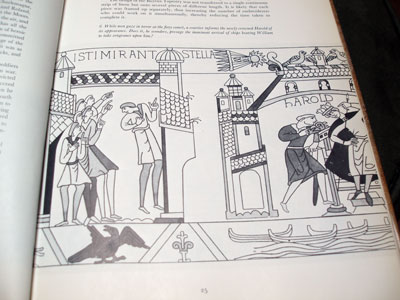
Spattered throughout the section on the early history of crewel embroidery, the author includes black and white drawings of sections of the Bayeux Tapestry. For historical embroidery buffs, these drawings would easily transfer into terrific designs.
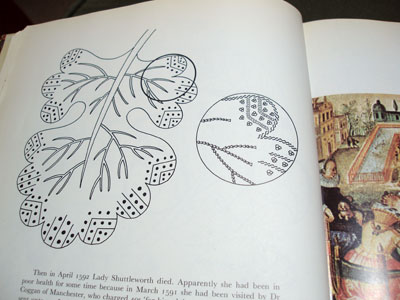
Moving into the Jacobean look, the author presents pictorial samples of different historical embroideries, and accompanies these with line drawings of the different elements within the samples. Next to the line drawings, she includes a magnified section that shows the stitches used is the particular element.
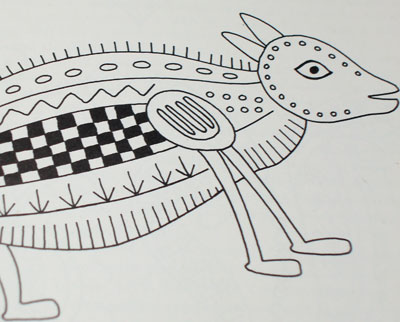
These line drawings of the different motifs found in the historical samples of crewel work abound throughout the book, and some of them are quite humorous. Imagine the embroiderer sitting at the frame, concocting different creatures to depict in wool - a great opportunity for creativity and a little fun. These little creatures remind me of the odd little elements that the illuminator included in the manuscript, or the sculptor incorporated into the creatures adorning cathedrals. A bit funny, a bit macabre, a bit bizarre - but always creative.
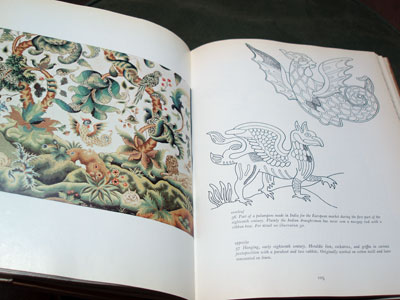
They layout of the historical samples juxtaposed with the line drawings are a terrific catalyst for embroidery inspiration. There's the line drawing - there's the original color scheme. Now, what can YOU do with the design?
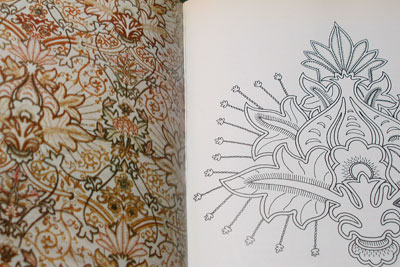
Some of the designs are easily imagined in other types of embroidery. For example, with this particular design, a goldwork motif comes to mind. Wouldn't it be grand?
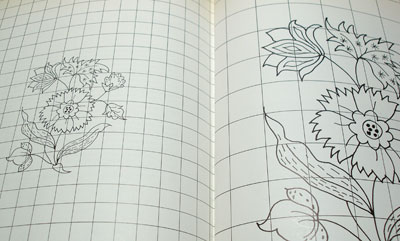
In the back of the book, the author gets down to the nitty-gritty of instruction, demonstrating, for example, how to enlarge or reduce a design by hand, using a grid. This is a good technique for drawing out a design in a suitable size, even though nowadays, computer graphics programs such as Photoshop, or simply a photocopy machine, can take care of this with a bit less time and effort. Still, to work it out with one's own hands does give a clearer sense of the elements in the pattern, and the slowness of the process gives the embroiderer time to really concentrate on stitch, color, and thread choices. Think of it as the difference between hand-writing a letter, which gives you time to really think about what you're saying and how it will come across to the reader, as opposed to whipping off an e-mail faster than you can really consider the impact of what you're saying! It never hurts to try your hand at drawing out your own design, using the grid method.
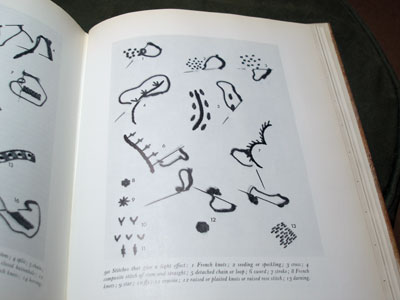
The quality of the book revolves around the historical information - which is written in a style that is interesting and easy to read and digest - and the design and technique discussions within the text of the book. For actual stitching instructions, the book falls a bit short. There are a couple pages that show the types of stitches commonly used in crewel work (as pictured above), but they don't go much into real instruction on stitching.
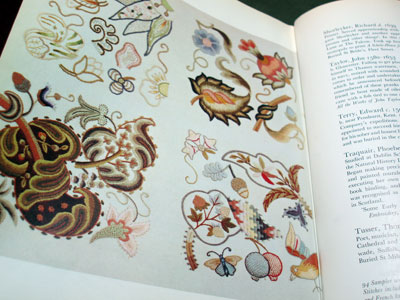
Still, the book is a wonderful source of inspiration for those interested in crewel embroidery. Though published in the 1970's, when crewel work enjoyed a notable revival, the book itself is timeless - an excellent study of the history of a technique and the designs and stitches associated with that technique throughout history.
If you're a fan of crewel embroidery or interested in general about the history of embroidery (especially in England), you will certainly find this book worthwhile to add to your collection! Look it up at your favorite used book sources - it can be had right now for a song!
|