|

|
2010-02-12 11:41:09.462-05 |
|
|
The folk embroidery of various countries fascinates me, so I was happy to see a recent post on The Textile Blog about Hungarian Flower Embroidery. The folk embroidery of Hungary is quite colorful, and, in its simplicity, I find it very appealing. After perusing the article on The Textile Blog, I found myself meandering about online, ending up at one of my favorite resources for online books.
Have you ever visited the On-Line Digital Archive of Documents on Weaving and Related Topics? It's a hefty title for a website. I just call it the Digital Archives. There, you will find some terrific books on all kinds of textile-related subjects. I found a couple books on folk art in particular, and both books feature some beautiful folk embroidery, needlelace, and related textile goods.
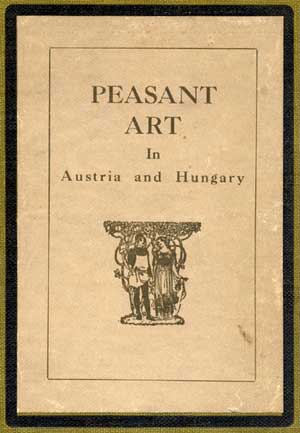
Both of the books I found myself browsing through are by author Charles Holme. The first is Peasant Art of Austria and Hungary, and though it covers more than just textiles, much of the content is dedicated to peasant costumes, embroidery, and needlelace.
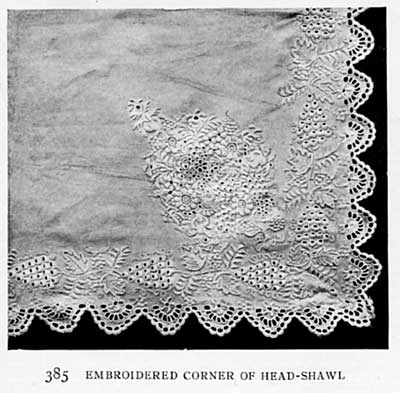
Various items of the peasant costumes from Austria and Hungary are featured throughout the book, like this head-shawl, adorned with beautiful eyelets, cutwork, and textured embroidery.
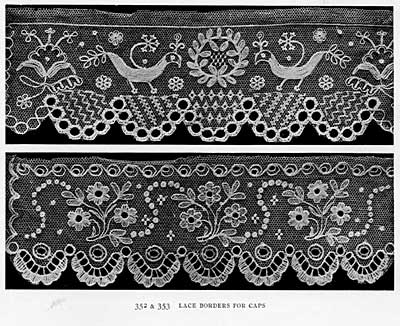
The hand-made laces - like these two laces embroidered on net ground - are a terrific source of inspiration for surface embroidery patterns of a folky nature. I love those birds!
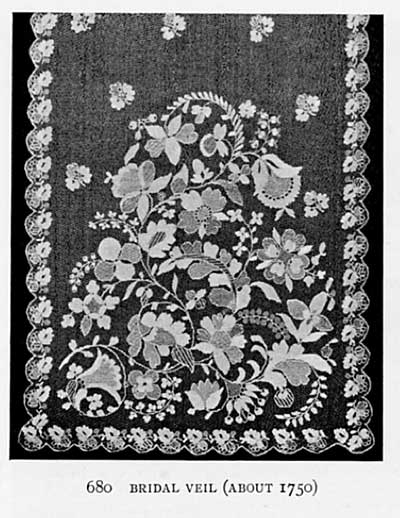
This bridal veil is exquisite. The design, embroidered on net and very light and delicate, would take on a completely different look if stitched in traditional Hungarian surface work, which is generally super colorful and somewhat heavy, as this photo from The Textile Blog demonstrates:
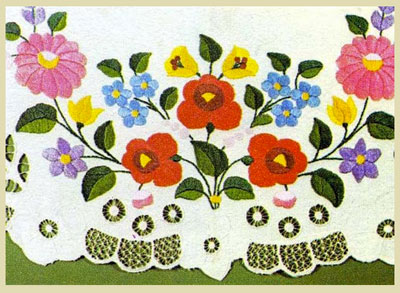
Though the types of needlework make both pieces look completely dissimilar, note that there are some elements in the flower designs that are look somewhat similar. I like both of these designs - the veil is certainly more elaborate and "formal," while the surface embroidery is simpler and somewhat "casual," but they're both beautiful in their own right.
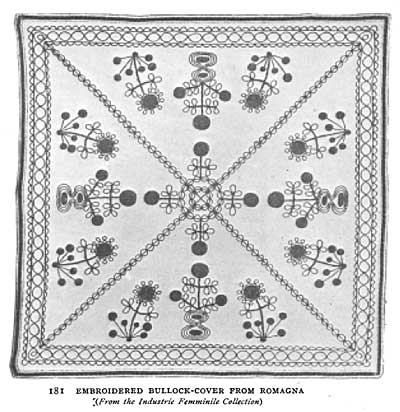
The other book by the same author is called Peasant Art in Italy. Can't you just imagine this nice piece of crisp linen embroidered in bold blues or reds and adorning a tea table?
But what is that description under the photo? An embroidered bullock cover? Are they kidding? What do they mean - I mean, really... what DO they mean? Surely, they wouldn't really cover a bull with that.
"What a beautiful tea cloth!"
"Thanks, but it's not a tea cloth."
"Oh, what is it?"
"It's a bull cover, of course."
I thought there was some discrepancy between the description of the cloth and my understanding of the description. Towards the end of the book, in the section on painted carts, I arrived at this picture:
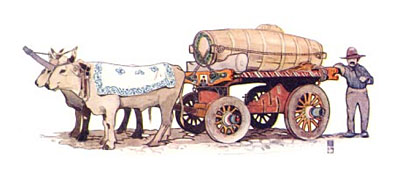
And so you see that a visit to the Digital Archives is always a learning experience!
I'm glad I don't have cattle. I might be tempted....
This weekend, if you're looking for a source of inspiration, some good reading on textile-related subjects, or just in the mood to browse good books, visit the Digital Archives. You can find these two books under the "H" section, by the author's last name.
Have a swell weekend!
|
|
|
|
|
