Last August, I showed you a wonderful collection of Society Silk (aka Silk Art Embroidery or Needlepainting) pieces that I received from a reader, along with a bunch of threads that belong to this historical embroidery movement that spanned the end of the 1800's through the beginning of the 1900's. This morning, I found an informative comment from Donna Cardwell, author of the book Silk Art Embroidery and the website The Society Silk Embroidery Collectors Club.
The comment that Donna left on the original post about Society Silk Embroidery is well worth reading, so I wanted to highlight it here, since last year's August article is probably pretty obscure right now.
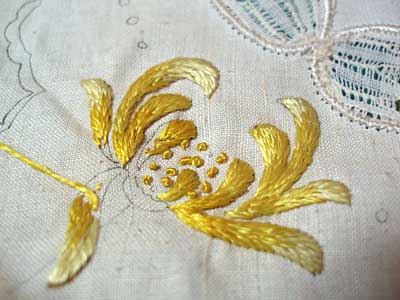
Society Silk (or Silk Art Embroidery) was an embroidery style popular from the mid 1880's into the second decade of the 1900's. On her website, Donna narrows the dates down to 1877-1912. The style featured typical Victorian designs, especially of flowers and vines and so forth, stitched with silk on linen in long and short stitch. The technique was taught to women in America in order to give them a source of income. You can read all about the history of the technique at the Society Silk Embroidery Collectors Club website. While you're there, do make sure you visit her picture gallery of Society Silk pieces - it is well worth a lingering browse!
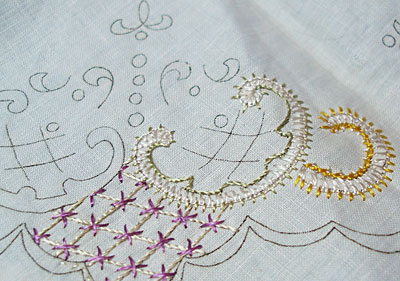
In my original article on the Society Silk pieces I received, I wondered about a few things: the difference in types of linens, the types of threads, whether or not the linens would wash up. Donna was kind enough to supply the following extensive answer to my musings:
Hi Mary, what lovely pieces. I was just wondering what you decided to do with them as far as washing the spots out. My experience has been that the pre-printed designs were made to wash out in the first wash ~ I don't think they will still be there if you try to immerse them in anything resembling soap and water (or even just plain water).
In my research for my book (Silk Art Embroidery, A Woman's History of Ornament & Empowerment), I purchased many, many pieces just like this that had been worked but never washed, and you could still see the design under the floss. When soaked, the design comes right out.
As far as the patterns themselves, the ladies could purchase the linens to be worked with the design already stamped; buy a Stamping kit and either copy the patterns from the many embroidery books; or they could design their own pattern and stamp them on whatever type of linen they wished. Some of the companies also offered them for sale at a higher price with the embroidery already started, which could explain the partly done embroidery on some of your pieces.
You are correct that the pieces could be purchased with the drawnwork and/or hemstitching already done. This was especially true of the smaller fine white linen teacloths that were so popular for teatime. I have several catalogs from which dealers actually purchased their stock of items to sell, and there are many different types of pieces such as this.
Also, the difference in the fabric and the designs is because in the beginning of the silk art embroidery movement in America (in 1877), fine white linen was the norm for most of the table linens. Closer to the end of the approximately 33-year period (1877 to 1910-1912 or so), they began to use the coarser, heavier fabric. They called the different fabrics "ticking," "brown burlap," "grey crash," "Tan Art Cloth," to name a few. The designs also turned away from the pure realism of the beginning time period to include more abstract "Arts & Crafts" and "William Morris" type motifs. In many cases, these linens were also shaded so that the volume of embroidery necessary to finish the piece was much less then from years past. Often they only worked the edges of these designs.
Also, they offered MANY different types of floss and the motifs look totally different when worked with differnt types ~ Richardson's sold "Filo," "Sicilian," "Grecian," "Rope Silk," "Wash Embroidery Twist," "Honiton Silk" (especially for use in Honiton Lace work), or "Mountmellick Silk." There are also different sizes of silk floss for different types of items ~ something that was used on the table had to be more sturdy, while a piece made to frame (which came into popularity in 1901) could be a little less sturdy and therefore more delicate floss could be used.
Ecclesiastical embroidery was very popular as mentioned, and though I've seen many patterns in the embroidery books, I've only seen one piece in real life (which I found after my book was published, so it's not in the book). I'll post a picture of it on my website if you would be interested in seeing it. [It's on the home page and also in the photo gallery - a gorgeous piece! MC]
By the way, many of your pieces have the very popular motif of maidenhair ferns stamped on them. Also, all of these are table linens. It was very common to purchase them in sets for the whole table. They consisted of a centerpiece and matching doilies.
Hope some of this helps. If I can answer any more questions, please feel free to contact me. You can do so through my website, www.societysilkembroidery.com.
You'll find Donna's website, Society Silk Embroidery, an informative and beautiful resource for those interested in this period and type of embroidery. Do stop by there and visit! And thank you, Donna, for the informative comment!
|