Chip work is a wonderfully sparkly filling technique used in goldwork embroidery. I think I'm part crow, because I love sparklies! So it isn't odd that chip work would make its way into my current goldwork project. Today, I'll show you where it's going and hot it gets there.
The goldwork pomegranate, when we last left it, had acquired a nice coating of smooth passing thread, a touch of pearl purl, and an outline in wavy check thread. This is what the piece looked like before getting into the chip work:
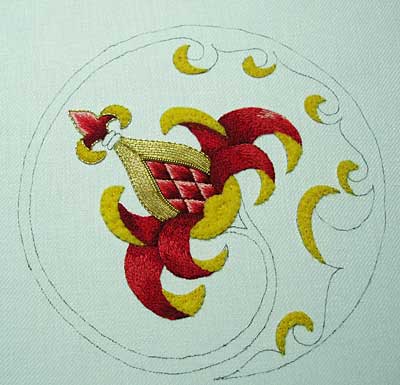
I apologize for the greenish tint in the photo. I'm longing for sunny days again - goldwork photographs much better in natural sunlight!
Now we're going to address the yellow felt areas on the tip of the pomegranate and on the larger turnovers on the "petals" protruding from the side of the fruit.
I'm working with Gild Bright Check Purl #7 (which I purchased from Hedgehog Handworks). This come in 18" lengths, and, if you're planning on following along with the project and doing what I do, then you'll probably want to order two 18" lengths. This will give you plenty of bright check purl for all the chip work in the design, plus a little left over for future projects (or to make up for mistakes!)
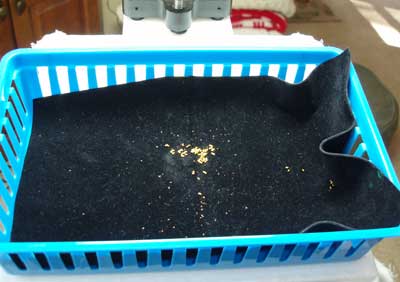
I use a piece of black velvet lining this plastic basket for cutting and holding my chips of purl. A box lid with a piece of velvet in it will work, or you can make your own velvet board for cutting your metal threads by adhering a piece of velvet or velveteen to a piece of mat board. You should use velvet or something with a short nap to cut on, as the nap of the velvet keeps things in place. I have a velvet board as well (in red) but since I had this basket on hand and the piece of black velvet, it served the purpose for this project.
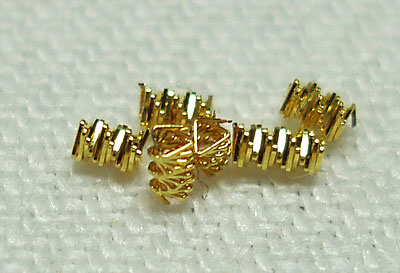
Bright check purl, also called "frieze," is made from a metal wire that is coiled like a triangle and twisted to make a faceted tube of spiraled gold wire that is loose and limp when left in long lengths. When it is cut into small "chips," the chips are a bit stiffer, but still retain the ability to be pulled or stretched out of their spring-like shape. They do not spring back, so if you pull check purl out of shape, it'll stay stretched out of shape.
The purl is cut carefully into small lengths - I usually cut them about 3 or 4 twists long, as in the photo above. They can be cut smaller, too, to fill in small spaces. When cut, they are like beads. You can see pretty clearly in the picture that, when cut, they make what could be described as a hollow, faceted gold wire bead.
To cut them, you can either leave your length of check purl on the velvet and place the tips of your scissors over it and snip, or you can, as I do, hold the check purl down next to the velvet close to the end where you're going to cut it, and then slide it onto the edge of your scissor blade. The purl will separate a bit over the scissor blade and snip without any crimping or warping.
They're pretty, aren't they? And they're a lot smaller than they look!
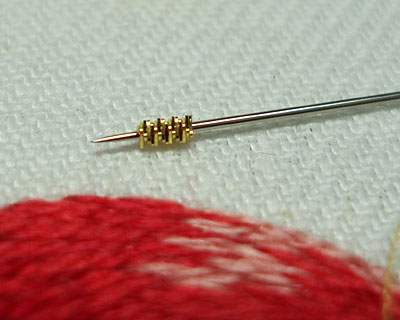
These little chips are picked up just like beads and sewn onto the gold felt padding in the same manner one would sew on beads. Here, you can see the needle picking up one little chip.
I'm using a #11 crewel needle (you can probably get away with a #10, which is more readily available than the smaller #11) and the same YLI 100 wt thread that I spoke of in article on smooth passing thread. My thread is waxed well, since the abrasion from the gold necessitates protection for the thread!
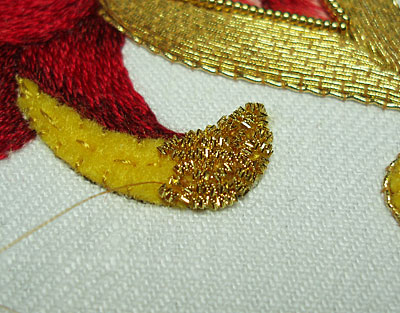
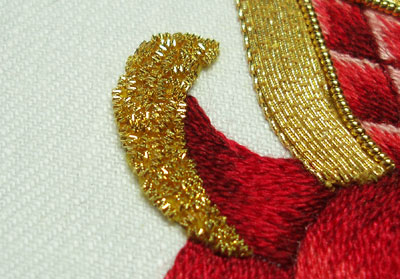
Here, I'm working on one of the turn-overs on the top petals next to the body of the pomegranate. The chips of gold are sewn on randomly, covering the felt. They should be stitched on in various directions, so that the light catches them well, and so that they fill the space as thoroughly as possible. Regarding filling, though, it is important not to crowd the chips so much that they buckle up on top of each other. They should fit snugly next to each other, but not bulge over each other. Since they have that spiral, springy nature, they will bend and buckle and bulge if they are crowded.
I did my best not to let the chips overflow the felt area, too. I am going to edge the felt with a different gold thread to give it a clean finish, and I don't want the chips to interfere with the outline.
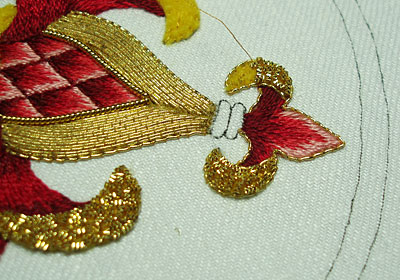
Using the same random sewing-on-of-chips, I filled in the turn-overs on the fleur de lys at the tip of the pomegranate as well. These, I fit into the outline of check thread that was already there, being careful not to cover the outline.
When filling with chip work, there may remain some tiny spaces of yellow felt that aren't covered between the chips. This is ok. The felt, because of its color, won't be noticeable.
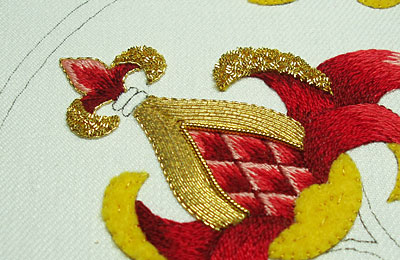
Photos don't do justice to the sparkly nature of chip work!
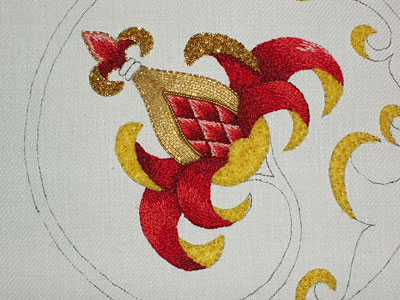
Pulling back a bit, this is the piece so far...
And then I moved over and finished the chip work on the other side of the fruit.
Chip work is fun! It's a bit tedious in a way, due to working with very small pieces of gold and having to take a lot of stitches to fill in an area. But really, it's simple stitching! And the results are worth it! It's great fun to watch an area fill up with chips of gold!
Next time we visit this project, we will look at outlining those turn-overs with one of my favorite edging techniques.
For previous posts on this goldwork embroidery project, please visit the following links:
Stylized Pomegranate Pattern used for this project
Setting up the Project on a Frame
Preparing the Ground Fabric with Felt Padding
Selecting Colors of Silk for the Project
The Stitching Begins - SIlk Shading
Continuing the silk shading - the left side
Finishing the silk shading
The Goldwork Begins: Smooth Passing Thread
Check Thread for Outlining
|