In keeping with the religious feast of today, Good Friday, I thought I would share some photos of some ecclesiastical embroidery. I find this piece featuring Christ carrying the cross rather interesting from a number of angles.
This is a hand embroidered medallion on the back of a chasuble. The piece, we will see, is actually a combination of techniques. From far away, it looks like it is completely hand stitched, but it isn't.
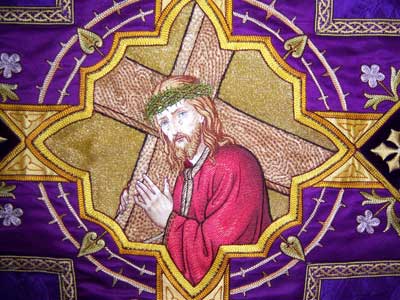
The first interesting thing that strikes me about this whole piece (and the vestment) is the use of color. It is not at all subdued! My preferences don't generally lean towards combinations of very bright colors on vestments. But this particular piece certainly makes use of some bright tones, and I think it does so effectively.
Remember, as we progress through these photos, that ecclesiastical embroidery is generally worked to be seen from a distance. You'll notice that embroidery in the photo above (with the image somewhat distant) looks very smooth.
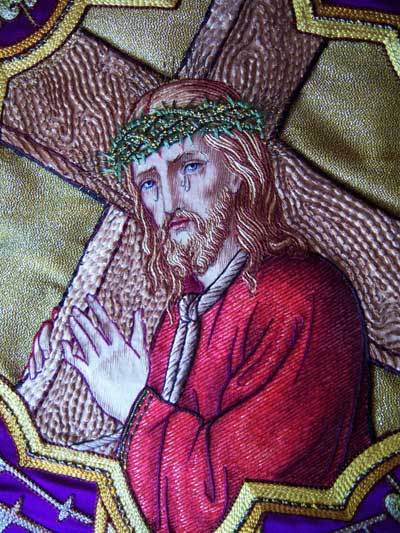
The different pieces of the image - the face, hands, cross, garments - are all actually from different fabric, appliquéd and then stitched over in certain areas. Certain areas, especially noticeable on the face, are also tinted, to provide a "painted" look. The effect, from far away, is that the face is embroidered with intricate shading, when in fact, the embroidery on the face is rather simple.
The texture on the cross is interesting. I think I like it better close up than I do from far away, but I suspect that from even farther away than the above photos allow, the cross probably looks better.
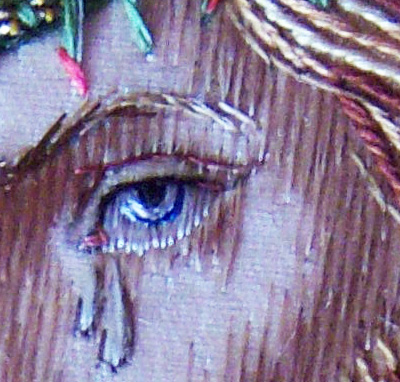
You can see here a close-up of the eye and the stitching around it. They eye is completely embroidered in blues and black and white. The stitches at the end of the whites of the eye - at the base - really catch the light, and the effect is one of watering eyes, fitting with the tears that flow down Christ's face.
Notice the stitching on top of the eye - a black line along the top of the eye, and then, at the crease of the eyelid, a dark mauve line is stitched. Notice, too, the corner of the eye, with the pink stitches. From far away, these are not noticeable - look up at the first picture again. But they all combine to form very clear facial details from far away.
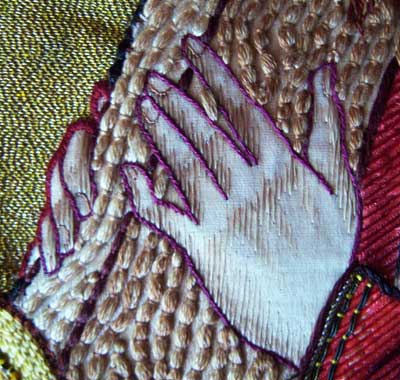
The hands, too, are only embroidered where shading is required. Notice that the outline of the hands is a very strange purple. Up close, this looks bizarre! But if you look at the first photo again, you can see that, from far away, it works.
You can see that the texture on the cross is made by couching a thick bundle of threads in a puffy couching technique.
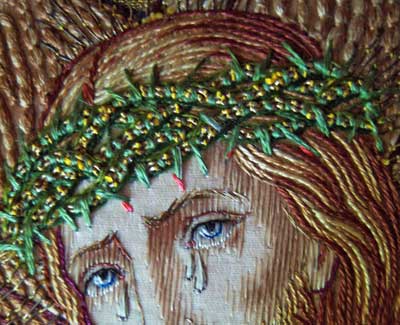
The hair is stitched in long curving lines of stem stitch, in various shades to give it depth.
The crown of thorns is rather uniquely executed. I've never seen a green rendition of the crown of thorns, and the way it is stitched is kind of interesting. Again, there's some nice texture here. The crown is apparently made out of two Japanese gold threads loosely twisted together, then couched with green floss. The couching stitches are close around the gold threads, and then, in spots, the green juts out to form a thorn. So you get glints of gold - just a little bit, not a lot - and the yellow in there is the core thread underneath the Japanese gold, where the gold wraps have been moved. Some of the thorns touching the face are tipped with pink. Notice that they aren't tipped with a bright red, which I think, from far away, would be too confusing to the eye. It would not be obviously blood, but rather darker spots, whereas the pink accentuates the tip of the thorn against the flesh. If you look at the second picture above, you can see this.
This whole piece is actually very simple. The image itself is not too full of detail - notice there is no background detail, for example. This style of hand embroidery combined with appliqué was worked on vestments from at least the late 1800's through the mid-1900's, and is actually still done today. The combination of appliqué and stitching reduced the production time on pieces that would otherwise have taken easily twice as long to embroider. It is humorous to read some of the old ecclesiastical embroidery books from the turn of the 20th century (early 1900's), where the authors insist that the combination of appliqué and embroidery should only be done when nothing else can be afforded!
|