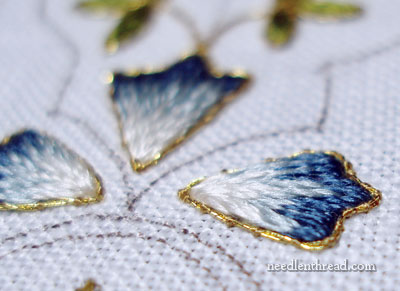
I’ve been working with the Elizabethan twist on the Floral Glove project. Elizabethan twist is a very fine goldwork thread – it’s actually two very fine goldwork threads, twisted lightly together. It’s lightweight and tiny stuff, and, couched along the outside of the a little embroidered element, it makes a nice outline.
The kit came with several yards of Elizabethan twist. When working with this thread on small elements, it’s best not to cut it, but to work from the full length. When working with the full length of any fine goldwork thread that is being couched to the surface of the fabric, I like the thread to be on something, not just loosely wound up. The obvious reason is that a loosely wound goldwork thread that is not wound onto something can become a pain in the neck to keep in order.
In Japanese embroidery, couched gold thread is wound on spools called “koma.” These sit on the fabric and the gold thread is wound off them as it is couched to the fabric. When I couch smooth passing thread in a large area (like the outline of my Agnus Dei project), I usually fold the whole length of thread I’ll be using in half (since it is often couched in pairs), then wind it from the fold onto a spare spool so I can pull the thread off the spool as I go. This makes it really easy to keep the passing thread in order. The spool sits fairly easily on the fabric, as passing thread has a little weight to it when a lot of it is wound onto one spool.
The first thing I did before beginning to work with the Elizabethan twist was take it out of the little bag it came in, where it was wound in a tidy ring, and wind it onto something. I happened to have an empty spool from my Blackwork Fish project, so I just used that. I wound on the Elizabethan twist, and then started to couch around the various elements on the glove project.
The difficulty was that the spool of twist was very light, so it wouldn’t stay in one place.
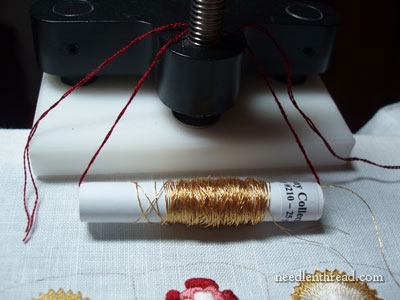
To rectify the situation and keep the spool in place while I was stitching, I rigged it. I had a little length of floss in my needlework box, so I ran it through the spool, tied it in a loop, and slipped the loop over the top of the bolt on my Needlework System 4 stand. This worked ok.
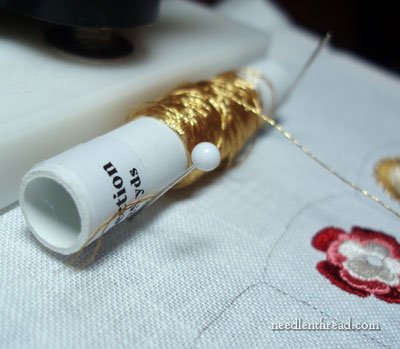
Another option that worked just as well (because the spool of thread is so light) was to stick pins or needles into the fabric and rest the spool against them.
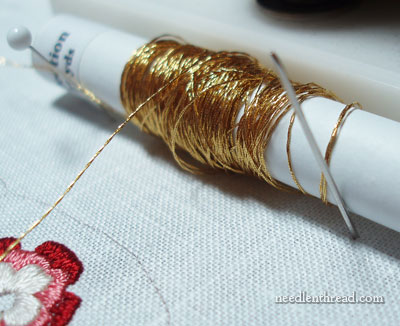
I only had one pin in my needlebook, but I had plenty of needles, so on one side, I stuck a pin, and on the other side, I stuck a needle. The spool rested against the two and stayed where I wanted it to stay.
Before working with Elizabethan twist, try spooling it and rigging it. You don’t need any fancy equipment – just use what you have lying about in your workbox. With metal threads, I wouldn’t wind them around a card or anything flat, though, because you don’t want then to kink. A leftover round spool from sewing thread or other embroidery thread works great. The heavier the spool, though, the more stable your “rigging” must be to keep the spool where you want it in your workspace. A pin and a needle stuck in the fabric probably wouldn’t hold a regular sewing thread spool very well, but they work fine for this light cardboard spool.
Have you ever rigged up your needlework space to make your stitching easier? Any tips for the rest of us? Leave a comment and let us know!