This cross & lily hand embroidery design is perfect for church linens. My niece and I are working together to embroider a couple palls, and this is the design she wants to use, so I thought I’d post it here for anyone else interested in it.
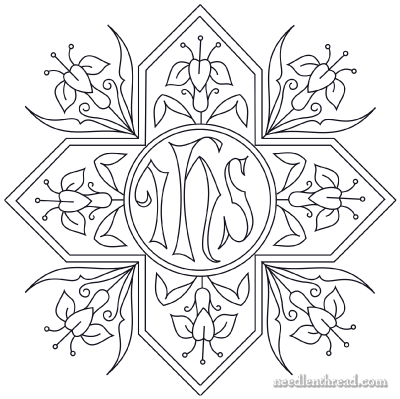
This hand embroidery pattern could be used on a number of church embroidery items, but it is particularly suitable for a pall. A pall is a square piece of linen that rests on top of the chalice during Mass, and it is often embellished with embroidery, or sometimes, it is painted. (I prefer embroidered palls to painted palls!) Linen palls range anywhere from very small (about 4″ square) to large (up to 8″ square), but the standard size is around 6″ to 6.5″ square.
The only “rule” for a pall is that the part of it that rests on the chalice must be linen, and normally, there’s a tiny red cross embroidered in the middle of the back of the pall that covers the chalice. In years past, palls were constructed from folded linen, the layers in the folding providing the stiffness to allow the piece to rest like a small cover on the chalice. The sides were stitched up to hold the folds together into a finished square. This type of pall has its advantages – it can be cleaned without being taken apart, and once dry, it is stiff.
In some places, the pall was (is) only one piece of linen, which draped over the chalice. This type of pall does serve the primary purpose of the pall, which is to keep foreign matter from landing in the wine during Mass; however, it is not as desirable as the stiff pall. The stiffness of the pall serves several purposes. It supports anything that is placed on it, and is easy to remove from the chalice and replace on the chalice without having to fiddle with draping fabric.
The standard pall today is made up kind of like a pocket from a long piece of linen that’s folded in half to form the square, and then sewn up on two sides, to form the “pocket.” Into the pocket, a piece of board (like mat board or stiff white card) is slid, and the fourth side of the square is then hand stitched closed. Sometimes, instead of linen, the “pocket” (or main body) of the pall is made out of silk or satin or another fine fabric, and then a linen square is attached to the back of the pall, so that the part of the pall resting on the chalice is linen. Silk and satin can be embellished with paint or with embroidery. For regular cleaning, normally just the linen square on the back of the pall is cleaned – it is snipped off, cleaned, pressed, and sewn back on.
Palls are not always white-on-white. The designs can be stitched in colors, in silk, cotton, or whatever your choice of thread may be. Real metal threads don’t have a place on palls, because all palls pretty much eventually need to be cleaned. Some folks use synthetic golds to stitch designs on palls. Personally, I’m a bit hesitant to do so. The results can sometimes be pretty garish. But perhaps the most enticing thing about making a pall is that it is the perfect size for considering the embellishment – which can range from very simple (or nothing at all!) to very elaborate, but all confined within a doable 6″ square. This is probably why I like making them!
I’m kind of a purist when it comes to the pall, though. I prefer white-on-white embroidery (though some day, I may venture into one color – who knows?), and I prefer 100% linen for the entire pall.
After the pall is embellished, sometimes an edging is added around it, like a fine lace or some delicate tatted lace or something to that effect. This edging can be added when the pall is sewn up, or, with certain types of lace, it can be added afterwards. For example, a tatted edging can be tacked just on the outside of the seam. An edging like the latter has an advantage: when the pall must be taken apart to be cleaned, the edging can be easily removed and replaced.
So that’s a pall, and those are the things I keep in mind when preparing to make one.
If you’re interested in having a copy of the design above, here’s the PDF version:
Cross & Lily Pall Pattern
Now, my next step is to sit down with my niece and figure out what stitches to use where on this design. Any suggestions?! I’m all ears, if you want to give me some ideas!