As the summer draws to a close (officially, it ends today for me), I’ve been frantically preparing to teach the Needle Arts class I mentioned a while back. I really appreciate everyone’s feedback on the subject – your comments were very encouraging and really helped get me fired up about the class!
“Needle Arts” is probably a misnomer, and I may discuss this with the school a bit later. My brief exposure to other needle arts besides embroidery is minimal – I can crochet, but I don’t do it much; I can knit only the simplest stitches; and aside from occasional needle tatting (in conjunction with needle lace), I don’t tat. In fact, mostly, I just embroider. (You’ve probably noticed that!) My focus, then, for the class, is only embroidery of various types. The first quarter is devoted to counted techniques, including cross stitch, blackwork, Assisi work, and petit point. The remainder of the year is devoted to learning stitches and applying the knowledge in various surface embroidery techniques. I won’t go into all the gory details right now, but said techniques will include, especially, crewel work and silk work.
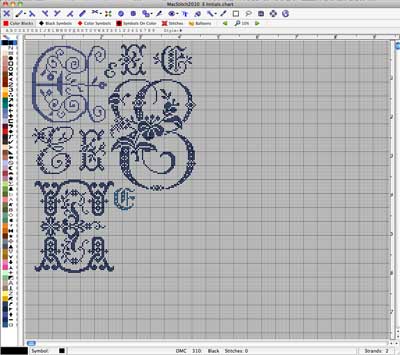
During the first semester, though, as far as the technique portion of the course is concerned, the students will be primarily learning stitches, first counted and then surface. They will incorporate the stitches into spot samplers. To this end, I’m putting together collections of cross stitch monograms so that the students can apply them to their samplers. They’ll have plenty of styles of monograms to choose from, to personalize their samplers. And then they’ll have plenty left over, for future projects if they want to use them.
I’m using MacStitch, which is an excellent and easy program for designing counted work. (If you don’t use a Mac, they have a Windows version…) The monogram designs I’m using are the old Sajou monograms that are offered on Pattern Maker in a variety of downloadable versions, one of which is MacStitch.
During the first quarter, we’ll be looking at the history of samplers, as well as the origins of materials and the different types of fibers. During the hands-on part of the course, the students will have a chance to use different fibers in different ways. They’ll be keeping a “Needlework Journal” that has space for samples, notes, instructions, and so forth, so that they can note types of threads, fabric, and stitch results and variations. Besides individual small samples, they’ll practice and elaborate on their samplers. By the end of the first semester, the students will have been exposed to a lot, as far as both information and stitching is concerned.
It’s during the second semester that the students will be working individual projects from start to finish. I’m of the opinion that it is difficult (if not impossible) to design projects and work them until you have an idea of the stitches and the materials of embroidery. It makes more sense to design and execute projects once you know something about stitches and embroidery materials. Hence the reasoning behind a semester devoted to basics, followed by a semester of application. The point, though, is not to have a “survey course” where students learn a skimming of everything, but rather a skills course, where they can actually spend time developing certain skills well, with a little depth.
I’m excited about teaching the class! But at this point, I could really use an extra week of preparation! Where did the summer go? Is it really true that time goes faster, the older we get? I think it must be – because I swear summer just started last week! Still, the school year must begin, and I suppose it will, whether I’m ready for it or not. Wish me luck, will you?!