The needlework project that’s consuming most of my stitching time lately – especially those 15 minute bouts of stitching – is this spot sampler for the high school level Needle Arts class that I’m currently teaching. I’m desperately trying to get Far, Far Ahead of my students, but I’m not quite as far enough ahead as I would like to be.
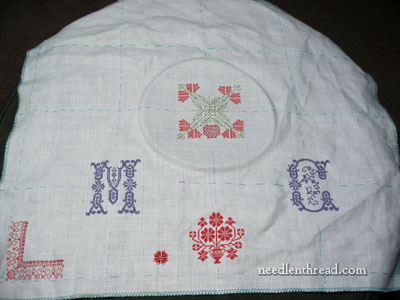
The first step in working the sampler was to apply initials. Signing the work usually comes at the finish line, but in this case, initials seemed a good place to start.
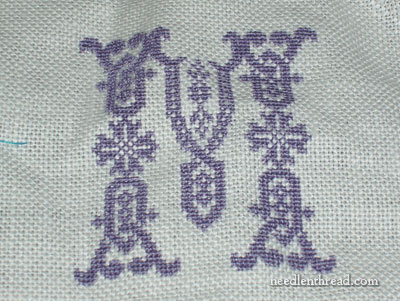
The first semester of the Needle Arts class is devoted to learning stitches, and the first quarter is devoted to learning counted stitches. The most basic counted stitches are the cross stitch and the backstitch, so those were first up. The initials were worked in cross stitch, then.
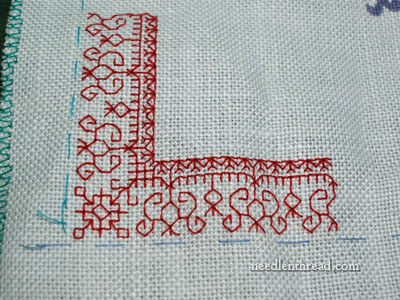
After cross stitch, we’re moving on to Holbein stitch, or reverse running stitch, or double running stitch, or one of the many other names by which the stitch is called. I like “Holbein stitch,” personally, because I like the historical association in the name (artist Hans Holbein the Younger, a 16h century painter, showed detailed blackwork embroidery in his portrait paintings…) Holbein stitch is the basis of blackwork, which is worked in such a way that it is more or less reversible – the design is the same on both sides of the fabric.
To incorporate some blackwork on my spot sampler, I chose a nice little corner design. Obviously, it’s not worked in black, but that’s ok – the technique is there, and that’s the point. I’ll probably talk a little bit more about the student samples for learning Holbein stitch and the various “journeys” involved in gridded blackwork later on.
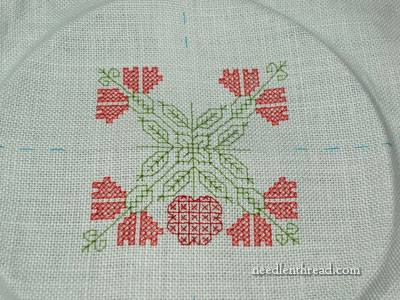
After finishing the corner design, I couldn’t just leave blackwork there. I wanted one more element of it on the sampler (it works up really quickly!), I decided on this design (not quite finished with it), which is a little larger than I intended. Initially, it was going to be stitched in only green, and the colors were added as an afterthought. They look ok, but it’s not exactly my “favorite.”
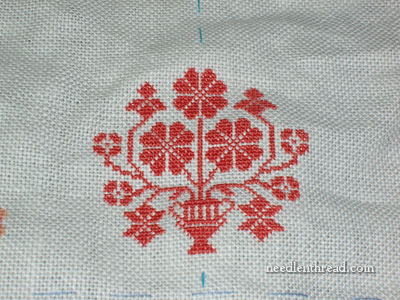
What’s an educational spot sampler without a Quaker motif on it? I added this one after working the initials. I’ll be stitching the date on each side of this little urn.
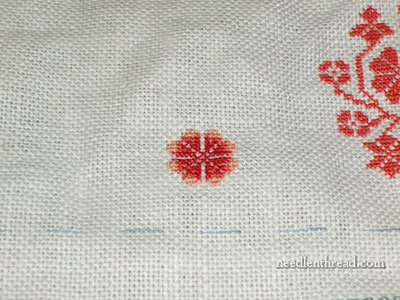
And here’s just a spot on the spot sampler. Using the Quaker motif, I extracted one flower and shaded it. I’ll put a corresponding one (or something similar) on the other side of the urn, eventually.
So that’s what I’m stitching on. After the blackwork element on the samplers, we’ll move on to other counted stitches, maybe a (very) small Assisi motif, some pattern darning, and some typical canvas stitches, some of which will be worked on this linen, and some of which will be worked in wool on canvas.
In addition to the spot sampler, I’ve got some behind-the-scenes developmental work going on with a major project, and I’d like to share that process with you eventually. But what I really NEED to do this week (*sigh*) is clean my studio. Why didn’t I think of building that as a self-cleaning studio? Just turn the knob, press the button, walk away…..
Tomorrow, I’ll be announcing the winner for the Stumpwork Tiles Book Give-Away. If you haven’t signed up yet, do visit the original post and join in!
Hope you had a terrific weekend!