Selecting colors of threads for an embroidery project can be a pretty daunting task! On the bright side, when it comes to working a spot sampler, you aren’t restricted in the same way as you would be if you were embroidering, for example, a picture.
I’ll tell you right off the bat that I’m no expert in color theory! But I’ll show you how I went about selecting colors for the spot sampler, in case it helps.
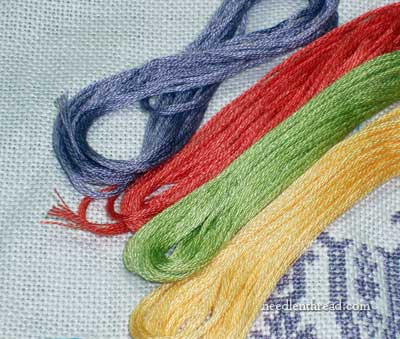
First of all, whenever I’m working on something like this sampler or anything else that leaves me pretty free to choose whatever colors I want (for example, embroidered flour sack towels that I use as basket liners for gifts, and so forth), I limit the number of color families I’m going to use to a maximum of four (and sometimes, fewer!). I also allow for some shades of brown, in case I need them for anything specific (in case an animal creeps into the sampler, for example… or a tree trunk…)
I don’t really take into consideration the ground color on this type of project, either, because for me, it’s usually white. (If you do use a colored fabric as a ground, you should take the fabric color into consideration and lay out your threads on the fabric to make sure they work together.)
I consider what the purpose of the project is: will the finished project be displayed, and if so, where? With the flour sack towel in the example above, I planned to line a gift basket with it, to give to my sister, who uses a lot of sunshiny colors in her summer table linens. So I chose the colors accordingly.
For the spot sampler, if I decide to frame it, I would want to hang it in a specific room in my house, so I took into account the colors in that room – periwinkle, white, and yellow. I added the coral for a touch of contrast, to brighten things up. The green works well with all the colors, and is necessary for stems and leaves, which will undoubtedly turn up at some point on the sampler.
So you see, it wasn’t a very scientific way of selecting colors, in my case! In fact, for projects like this, I think color selection can be very subjective, unless you’re trying to imitate a historical sampler or something of that nature.
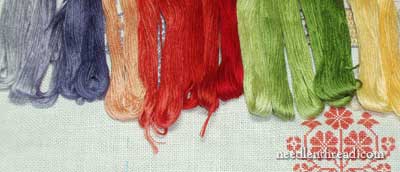
While I only have four color families for the sampler, I have a range of shades within those color families. This will allow me to do some shading, to add a bit of depth to different elements, and to combine different shade ranges of different colors for a little variety.
The sampler is primarily being worked with a 6-stranded cotton floss right now. I’m using Cosmo embroidery floss for my sampler, but my high school students are using DMC, because it is readily available and less expensive. I chose to use the Cosmo to avoid using class supplies.
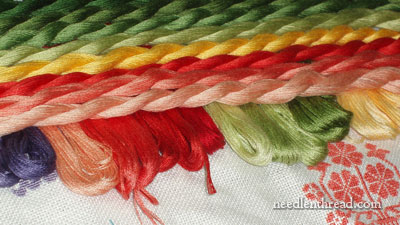
But I’ve also selected some DMC floche from my stash, in a matching range of colors and shades. I’m not sure I’ll actually incorporate any on my sampler, though, since my students won’t be stitching with floche. It’s a fairly limited-budget class (16 students at $80 each for the year). I need to make sure we have the funds for next semester’s work. So I’ve had to make some prudent decisions on materials, one of which is that, for learning stitches, we’ll stick with the less-expensive DMC stranded cotton. And hey. It works!
But for your sampler, you might consider various types of thread. A sampler is a great way to get familiar not only with stitches, but also with different threads. And the combined results in one piece of needlework can be very interesting. (Come to think of it, it could also be ghastly, so choose with discretion!)
That’s how I went about my color and thread selection process: 1. I limited my color palette to a maximum of four colors (and if necessary, some matching browns); 2. I considered whether the finished project would be displayed, and if so, where; 3. I chose a range of shades within the color families; and 4. I went through my stash and picked out other types of threads (floche, in this case) in coordinating colors.
For those who struggle choosing colors, by the way, here’s some great news: Trish Burr is writing a new book on color selection in needlework, due out next year! I’m looking forward to that!
If you’re interested in following along with this whole Spot Sampler Series, please visit my previous post on selecting and setting up fabric for a spot sampler.
And finally, if you have any input on how you go about selecting colors for your projects, do share! Leave a comment below with any tips or suggestions!