Running out of thread when there’s only four more stitches to go is one of the Absolutes in the Life of the Stitcher.
It’s also one of those wonderful little aggravating trials that makes people of a certain personality (take me, for instance!) want to swear (under my breath, of course…). It’s a Riffemrackemfrickemfrackem Moment!
I’ve been working up instructions for doing the chain stitch and some of its variations, and while I was chain-stitching along, It happened. I ran out of thread with just over an inch left to stitch.
Aha! A perfect teaching opportunity, because you know what? It will probably happen to you some day, too, if it hasn’t happened already. As my Dad would say, “It’s a has or it’s a gonna.” One day, you’ll be chain-stitching along, and bammo! You’ll have about an inch of thread left and four more stitches to go. Instead of cursing under your breath, though, you’ll remember that switching threads is not so difficult as all that and that it’s even – yes – fun.
(Ok, fine. I admit this might be a stretch. It would be easier not to have to change the thread. But we’re trying to be optimistic here!)
So here’s a little photo tutorial on how to change threads when chain stitching. First we’ll talk about the technically INcorrect way to change the thread, then I’ll show you the technically correct way to change the thread, and then… I’ll admit that you don’t always have to be technically correct.
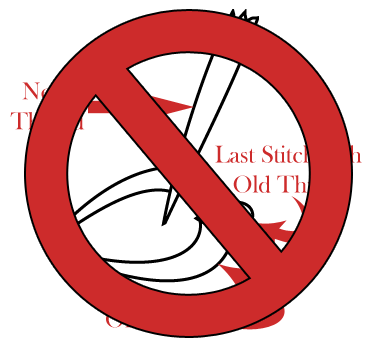
First, let us talk about the technically INcorrect way to change the thread.
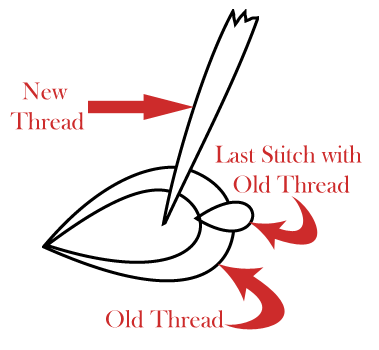
Easy-peasy as it may be, the diagram above is not the technically correct way to switch to a new thread when you’re working chain stitch. In the diagram above, the old thread is finished with the typical anchor stitch that comes at the end of a line of chain stitch. Then the new thread is brought up inside the last loop of the chain stitch, and regular chain stitching commences from there, over the anchor thread.
And this is technically incorrect.
Let’s look at the technically correct way to switch threads out on chain stitch.
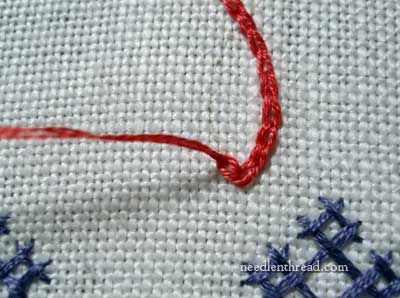
In the photo above, that little tail sticking off to the left was just about all that was left of my working thread, so it was time to make a switch.
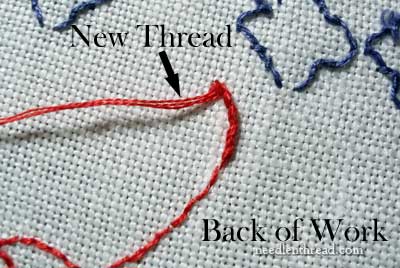
Leaving the old thread on the front of the fabric for now, I threaded a needle with the new thread, turned the work over, and anchored the new thread by whip-stitching around the stitches on the back of the work. I haven’t ended the old thread yet – it’s just hanging around on the front of the fabric while I work on the back with the new thread.
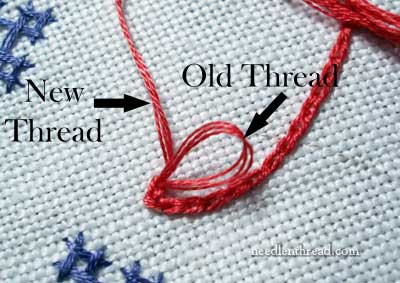
Now that the new thread is started, I flipped the work over. I took the old thread to the back, by going down in the same hole, as if I were making another chain stitch. I left a good size loop on the front, and brought the new thread to the front of the fabric, one stitch length forward. The new thread comes up for the first time at the same place where the next chain stitch (not the one we’re doing now with the old thread) would start.
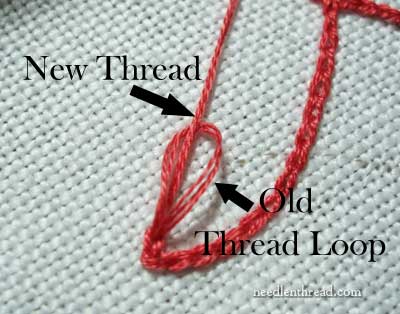
I brought the new thread inside the loop formed by the old thread (the tail of which is still on the back of the fabric at this point). I made sure the new thread was pulled forward in the direction of the chain stitch line, because the new thread is going to form the “anchor” for the loop of the old thread. (Are you with me still?!)
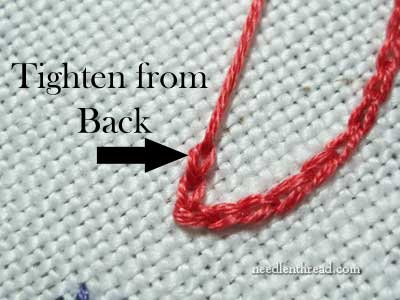
Pulling from the back of the work on the old thread, I tightened that loop around the new thread that’s pulled forward on the front of the fabric.
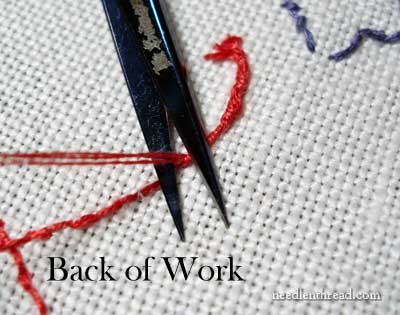
Now, I can treat the tail of the old thread on the back in two ways. I can leave it back there, and make sure I stitch over it with the new chain stitches. Or, I could just get it out of the way, by running it around the stitches on the back, and cutting it off, which is what I did at this point. If you choose to run it under the stitches on the back, be careful not to pull it tightly as you do so, because you don’t want to pull the loop on the front out of shape.
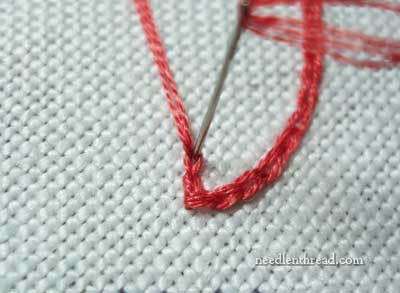
With the old thread taken care of, I turned the work back over and proceeded to chain stitch with the new thread. Voilá! The join is made, and no one is the wiser.
Now let’s be technically incorrect for a little bit!
Sometimes, it really doesn’t matter which technique you use to switch your threads in chain stitch. That is: it doesn’t matter, because no one will be able to notice the difference.
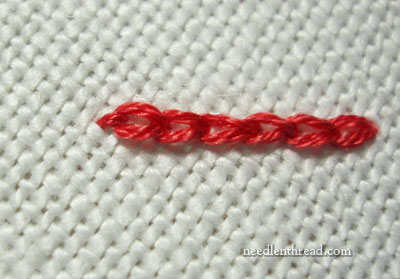
Here’s a short chain stitch line, and I’ve ended it on the left with a regular anchor stitch.
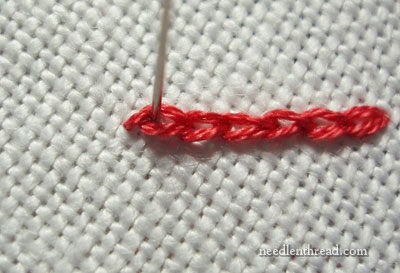
I’m bringing my needle up into the last loop, which is already anchored down (just like I said not to do, up above!).
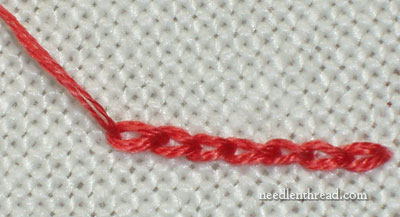
And there’s the first new stitch, on the left, which was taken over the anchor stitch.
Can you tell?
Not really.
Is it cheating?
Not really.
BUT (there’s always a but!) – the technically INcorrect way doesn’t always work with every thread. Especially if you are using finer threads, or you have larger loops that are more open, the anchor stitch can be quite evident. But if you’re using several strands of regular floss, or even a heavier pearl cotton, normally the anchor stitch isn’t really noticeable, and you can get away with being Technically Incorrect.
How do you switch threads when chain stitching? Are you a technically correct or a technically incorrect person? I admit I’m both! I just depends on the thread I’m using, really.
Switching threads isn’t the Biggest Question when chain stitching – I’ll show you a more obvious problem with chain stitch later this week, when you can see a clear difference if you do this particular thing the wrong way. Also, later this week, I’ll be giving away another book, showing you some progress on my spot sampler, putting up another step in Developing a Spot Sampler, engaging in a little Hoop Talk, and discussing a satin stitch dilemma.
Hope you have a terrific week!