The question of transferring hand embroidery designs to fabric is a mighty one. I’ve discussed it quite a bit here on Needle ‘n Thread, because it is the Most Frequently Asked Embroidery Question from beginners.
And gosh, let’s face it. We’re all looking for the dream method of design transfer – that perfect way to get the design precisely and as painlessly as possible onto the fabric, in such a way that it is invisible on the finished product, but easy to see – in all its detail – while the project is being stitched. This dream method, by the way, doesn’t exist absolutely – there are a variety of methods for transferring patterns, and which one you choose often depends upon the type of embroidery project you’re working.
That being said, my curiosity was piqued by this stuff called Transfer-eze. Lately, there’s been some buzz about this new product, which is supposed to make all the anguish over transferring designs to fabric magically disappear. It is, in effect, an adhesive water-soluble, printable stabilizer. I thought it essential to procure some of the stuff with the eventual intention of trying it out, so when Wooly Thread announced that they carry it, I bought some so that I could try it out and tell you about it.
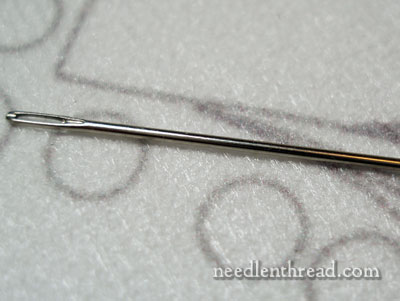
See the needle in the photo above? It’s resting on a piece of Transfer-eze printed with the holly boughs embroidery pattern I posted yesterday. You can see the kind of “fuzzy-shiney” matter of the stuff in the photo. It looks like – and feels like – a light-to-medium weight fusible interfacing. The Transfer-eze adheres to paper (freezer paper, I assume) that supports it while it feeds through your ink-jet printer.

I enlarged the holly boughs pattern slightly before I printed it. I also reduced the opacity of the design, so that the lines were not as dark as they would be when printed on normal paper at the normal setting. The printable size of the Transfer-eze is 8.5″ x 11″ – standard American letter-sized. It feeds through the printer so that the rough side (the stuff itself, not the paper upon which it is mounted) takes the printing. I had no problem in the printing of the stuff. It went through the printer fine – though the ink did blot up on the edge a tad, but I believe that is due to the design running up to the left edge of the paper.

After printing the design, the instructions say to cut away the excess Transfer-Eze around the design. I did this. And then I situated the design where I wanted it, on the corner of a flour sack towel. I use the large “deluxe” flour sack towels from American Chair Store, because, quite simply, they are the best flour sack towels I’ve come across. They’re square, large, a nice firm weave (not gauzy), and they make a nice liner for a large bread basket, with plenty of towel left over to fold over warm bread. This is really the only thing I ever use embroidered flour sack towels for. Think gift here, especially for wedding showers, house warmings, special visits, and so forth – a basket, lined with an embroidered towel, filled with some necessities, or goodies and a bottle of wine or some coffee, with the towel folded on top showing off the embroidery. It’s my standard special occasion gift. Invite me for dinner, and you’ll see!
Sorry for the aside. Really, I’m not trying to garner dinner invitations.
So there we are, with the design resting where it’s going to be stitched.

The next step is to peel the Transfer-Eze off the paper backing. This reveals the adhesive side of the stuff. It isn’t a super-strong adhesive. But you can definitely see it here – it’s shiny and a bit tacky (as in sticky).
Once you’ve peeled the paper backing away, you situate the Transfer-Eze where you want it on your fabric, sticky-side down, and smooth it out onto the fabric, so that it adheres. If you make a mistake in the placement of the stuff, you can carefully peel it off and re-situate it.

The Transfer-Eze adheres to the fabric like a thin film that feels, again, a lot like a fusible interfacing.
Some reviews online mention that there is really no noticeable difference between stitching with or without the Transfer-Eze, as far as the feel is concerned, and as far as any sticky gunk building up on the needle. So far, this hasn’t been my experience precisely. There is definitely a noticeable difference between stitching with Transfer-Eze and stitching without it. This doesn’t mean that it’s a negative difference, but the stuff is certainly noticeable! It stiffens up the fabric quite a bit – so much so, that I find a hoop redundant. I can hold the fabric with the Transfer-Eze on it in my left hand, and it pretty much holds itself out straight and stiff. It makes for a firm fabric surface, but it isn’t difficult to stitch through. Stitching is easy enough, and there is no gunky build up on the needle.
If you’re used to seeing the weave of your fabric when you stitch, you won’t with Transfer-Eze. It’s opaque. If you’re used to stitching with the sewing method, and manipulating your fabric into a fold or bend with certain stitches, this becomes somewhat difficult with the Transfer-Eze, especially if you’re working very small stitches. With average sized stitches, though, it is manageable.
It requires a little more gusto with the needle, to get through the Transfer-Eze – a little more force to take a stitch… but not enough to be uncomfortable.
For me, the proof of Transfer-Eze’s usefulness will be in the final outcome of the piece. I will be interested to see if, when all is said and done, and the stuff is washed away, my stitching looks ok, and the fabric itself is as smooth as it would be, had I stitched straight on the fabric held in a hoop.
One thing that I am certain of: because Transfer-Eze is made of I-don’t-know-what, and because it is supposed to be a water-soluble transfer medium, it is not something I would use on fine embroidery. I don’t mind using it on cotton, with cotton threads, on pieces that will normally have to undergo washing. But since I don’t know what kind of residue is left (maybe not visible… but residue nonetheless) and because I don’t know the long-term effects of such chemical substances on threads and textiles, I would not venture to use Transfer-Eze as a transfer medium on fine embroidery projects that involve, for example, silk and pricey linen.
But so far, for this kind of embroidery project, I have to admit, it was pretty easy-peasy, setting the whole thing up! I mean, really. What could be easier – print the design, stick it to the fabric, and start stitching. No bother with a hoop, no tracing…. in a minute or so, you’re good to go. So for ease of use, on items that are meant to be washed, I think the stuff is pretty good.
I’ll follow up with the results once I finish stitching the holly and rinse the stuff away. In fact, I’ll line it up to some similar embroidery, done without Transfer-Eze, if possible. Just to see, you know….. After all, the finished product is what it’s all about!
If you want to try out Transfer-Eze for yourself, you can find it available at Wooly Thread.
I’ll share the finish with you on this project in the upcoming days, and let you know my final impressions of the product.
What about you? Have you had any experience with Transfer-Eze? Do you have any input on using this type of product with your embroidery? If so, please do leave a comment!