Hand embroidery does not have to be complicated in order to be effective. Take, for example, the under-rated, under-estimated, under-valued, plain-old-every-day straight stitch.
The straight stitch is exactly what it sounds like: a straight stitch. It is the most basic stitch. You bring your needle up in the fabric at some point, and you take it down at another point, pull your thread through, and voilá! You have a straight stitch formed between those two points. You can’t get more basic than that!
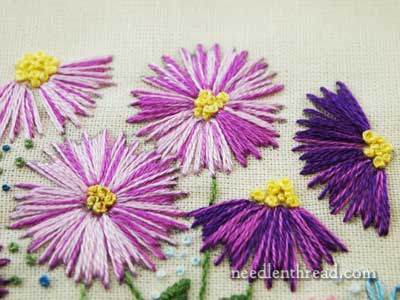
But see? Straight stitch can be quite effective! By fanning out straight stitches from a center point and making their outer edge a bit jagged, you can create a pretty nice embroidered flower.

Notice there’s no real regularity in those flowers. The stitches aren’t meant to be smooth and packed close together, like they would be if you were using satin stitch. They fan out, there are split areas between clumps of them. And that’s good – it makes them look more realistic.

Work with three or so shades of a color (lights and darks of the same color, and a mid-tone, too) and alternate the use of light and dark in some of your flowers, and mid-tones and dark in others, and mid-tones and lights in others (and maybe all three in still others!). Sometimes, alternate your thread colors in stitches right next to each other, or work several stitches in one shade and then switch to the other. Be a bit random around the flower, and you’ll get a more realistic result.
Clump together some French knots in the middle of your straight stitch flower, and you’re good to go!
Simple, effective, basic hand embroidery – who says needlework has to be complicated?