About eight years ago, bumming around Kansas City one day, I ventured into an antique store wherein I found one of those happy little treasures – a complete set of vintage table linens, including a table runner, what I think must be a tea tray liner or sideboard cloth (larger than a placemat, but not long and narrow like a table runner), eight placemats, eight napkins. They were an oatmeal-ish color and in very good condition. I liked their simplicity, and I liked the drawn thread work and embroidery that adorned them. And the price was actually very good. They were asking $60 for the set, so I thought it would be All Wrong just to leave them there. I almost felt morally obliged to take them home! Heck, I just like vintage linens. I didn’t really need to convince myself…. (Are you with me?)
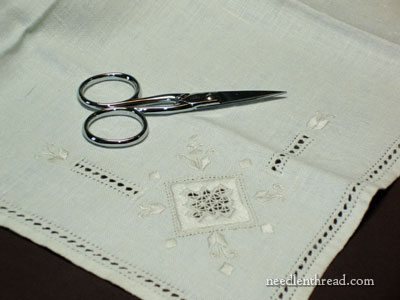
Well, it so happens that, recently, through a reliable online seller, I came across a collection of five vintage table napkins (one of which is pictured above) that were being sold as Lefkara lace. I recognized similarities between this set of five napkins and the set I had purchased in KC years before, so I purchased them in order to be able to compare the linens.
That’s the background information. Here are pictures of both sets of linens, focusing mainly on the embroidered motifs and the small areas of drawn thread work. I’m not really certain whether or not one or both or neither are definitely Lefkara lace, but the drawn thread areas do have that look, and I just like the linens. What do you think? Lefkara, or no? If you’re familiar with Lefkara techniques, you’ll probably know better than I would!

This is from the most recent set purchased, of five linen napkins sold as Lefkara lace. There isn’t a lot of needlework on each piece; just one corner is adorned as above, with the drawn thread square in the middle and the geometric figures on the side. The square is further outlined with a Four-sided Stitch edge and then surrounded with little geometric motifs, and there are two short drawn thread strips that match the outer decorative edge.

This photo is actually of the back of the linen – you can see how time has really relaxed the threads. They undulate softly. The thread looks like coton a broder to me.
So that’s what the napkins sold online as vintage linens with Lefkara lace look like.

This is the corner of one of the cloth napkins that I bought in KC eight years ago. On the napkins, the only adornment is this geometric figure embroidered in the corner, with a small strip of four-sided stitch underneath it.

The linen on the left is the KC linen from 8 years ago; the linen on the right is the one I bought recently online. The edges are the same.

This the table runner from the KC linens, from the back of the linen. (I always look at the back of linens that are sold as hand embroidered – it’s much easier to verify that they are hand embroidered). You can see the cutwork diamond areas here – not quite the same as the drawn thread “grid” on the more recently purchased napkins, but still slightly similar, with the wrapped bars. And of course, there’s the whole geometric motif thing going on.

Here’s the front of the same motif.
Both sets of linen are similar in overall look and style, though when you get down to the details, they aren’t identical.
I have the book “Lefkara Lace Embroidery: Historical Development, Designs, & Techniques” by Androula Hadjiyiasemi, but I’ve never actually read the book. Time to get it out and do some exploring!
What about you? Do you like vintage linens? Do you need someone to twist your arm if you come across nice ones (that are affordable for you) in antique stores and so forth? Big point of curiosity: If you are a vintage linen connoisseur, what do you do with yours? Do you use ‘em? Or store ‘em? (I’m of two minds on that question – more on that topic later!)