When talking pins and needles on a needlework blog written near the end of the school year by a teacher, I guess we could approach the subject two ways: metaphorically or literally. Metaphorically, I’m in the same state as most students at this time of year: a bright cloud of anticipation is hovering over me as we get closer to The End. But in every end, there’s a beginning, and in my case, the beginning of the summer signals a time for fulfilling all those solid plans and even wispy daydreams of the Creative. So, yep, I’m on pins and needles in that regard, kind of floating in a state of suspension while struggling to remain very focused on my job.
Literally, though, let’s talk pins and needles – you know, real pins and needles. The-tools-of-the-trade pins and needles. You know the kind!
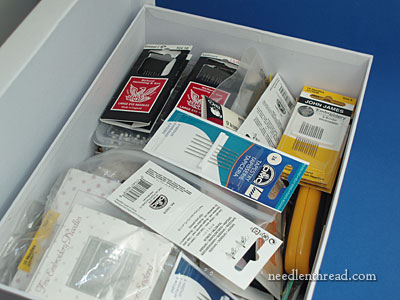
I have a lot of needles on hand – probably more than I will use in the next ten years. This surplus of embroidery and sewing needles has led to some strange consequences. How often do you have neighbors, friends, family members, and so forth stopping at your house to ask if you have an extra needle? I envy the folks who get to lend eggs and cups of sugar – cooking ingredients seem so much friendlier, after all, than a needle!
Another consequence of having a plethora of needles and types of needles on hand is having a storage solution for them. I’ll admit that I don’t have a “solution.” I just have storage! I use “archival” acid-free photo boxes for a lot of my needlework supplies, especially goldwork threads, some floss, and even some fabrics (though I prefer rolling fabric to folding it). And pins and needles.

I don’t think it’s necessary to use archival boxes for needles and pins, really. But for me, they’re a good size for stacking on shelves (some the size of a shoe box, some a double shoe box), they were inexpensive (I found a heap of them on sale at a camera shop – all white), and they have this handy-dandy label spot on the front, for labeling the contents of the box.

But while all that “stacked box stuff” may sound very organized when talking about the shelf, you can see that the inside of the box is not so impressive. And yet – everything I need, needle-wise, is there. I’m considering putting little file separators in my box, so I can sort by type and size, but it’s not high on my To-Do list right now!
The majority of my needles are John James needles, because: 1. they’re good needles; and 2. they’re pretty widely available. I also use S. Thomas & Sons, Richard Hemming, Bohin, and occasionally (if I need a specific needle I don’t have and I’m at a local craft store) DMC needles. I use Mary Arden needles, especially for beading needles; I use Peacemakers needles. I use needles from Wendy Schoen Designs. I use Foxglove Garden needles, especially milliners, because they carry them up to a size 11. For really fine embroidery, I use Pony needles because they’re the only brand I can find that has a size 11 and size 12 crewel (although Wendy Schoen does carry a #12 crewel).
The moral of the story is, I don’t stick only with one brand of needle. But I do believe some needles are better than others. Just an example: I’ll always choose a John James needle over a Richard Hemming, if given a choice, because I’ve experienced too many eye burrs in Richard Hemming needles.
If you’re wondering what needle to use for what (and with what thread or how much thread), there’s an excellent embroidery needle reference chart on the Country Bumpkin website. It’s definitely worth bookmarking!
So there’s a little Needle Talk for you today, along with some resources and a link to a good reference chart. (Incidentally, as far as pins go, I store them in the same box as my needles!)
What about you? How do you store your surplus needles? Are you very organized with them? Go ahead – leave a comment and let’s talk needles!