Lefkara Lace Embroidery by Androula Hadjiyiasemi is perhaps the only thorough book written on Lefkara lace. I’ve hesitated to review the book, because it’s Really Hard to find at an affordable price. So far, I’ve only found one or two copies online, and they’re running about $90. Today, I’ll show you what the book is like, so that, if you are are interested in Lefkara lace, you can decide whether or not it’s worth the investment to buy a used copy of the book or the effort to hunt one down somewhere! The library system can be very handy for this, though I haven’t found the book available in many collections.
While I take you through the book, I’ll point out some differences between Lefkara and Hardanger embroidery, too. Many folks saw similarities between the vintage linens I wrote about the other day and Hardanger. There are definite similarities, but Lefkara leans more heavily on the traditions of Italian needle laces. The book clearly points out the connections and gives an excellent history of the development of Lefkara lace.

Lefkara Lace Embroidery is a hefty book in a number of ways. It weighs a lot for a paper back, for one thing. It’s packed with information on the history of Lefkara lace, the various designs used in the technique, instructions for working Lefkara lace, and, throughout the book, there are photos galore. The instructions take the reader through each stage of work, from preparing the cloth, cutting the threads, binding the edges of the cut areas, adding central fillings, working a variety of fillings, working the embroidered parts of the linen, working the hemstitched edges, and working the decorative edges of the finished piece. One point that comes clearly across through all the instruction is that there is order and method in working Lefkara lace, but at the same time, there’s a vast amount of creative freedom in choosing design and embellishment, because there are so many combinations of fillings and stitched elements possible.

The book begins with a history of Lefkara lace and traces the development of it to the Venetian needle laces. You can see here an adaptation of Venetian needle lace in what the the Cyprians called “Bittotó.” The ladies of Lefkara eventually added certain motifs to the whitework styles that came from Venice, especially the satin stitched motifs typical in Lefkara lace, which they took from the art and surroundings of Cyprus. The author thoroughly covers the development of Lefkara lace, and it’s very interesting to read!
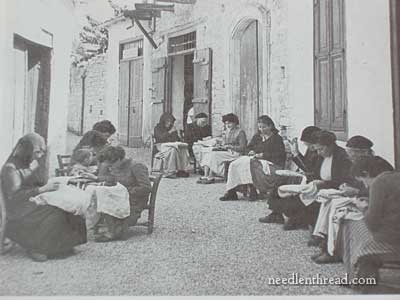
She supports the history with magnificent photos of the lace-making industry, along with up-close photos of old styles of Lefkara lace.

The older styles of Lefkara lace sometimes include elaborate edgings tipped with fringe.

As the styles developed, though, the edgings became less elaborate, and the scalloped edge in the photo above is more typical of Lefkara lace over the last century.

This is a more complex Lefkara edging which is not seen too often anymore, according to the author. The funny thing is, if I were to teach myself to work any of the techniques involved in Lefkara lace, this would be the one I would concentrate on. I love this edging! Incidentally, the ladies who worked this lace when the hand-made lace industry was strong didn’t necessarily work every element of the lace on a given piece. One person might cut the threads and do the initial binding or edging on the cut areas; another might work the surface embroidery; another, the elaborate fillings; another, the edging. This approach is typical to the cottage lace-making industries – it is the same way that Alençon lace in France used to be made, for example.

The author then proceeds step-by-step through the making of a piece of Lefkara lace. Here, you see a major difference between Lefkara lace and Hardanger. The threads in the linen for Lefkara lace are cut before any stitching is done. Also, the linen is much finer – from 40 to 50 count.

The technique part of the book is full of these close up photos of the various steps involved in making Lefkara lace. In this way, I think the book, published in 1987, is before its time. These thorough close-up photos of step-by-step processes in needlework didn’t become typical of needlework books until the mid-90’s, really. Occasionally, you’d find books with clear step-by-steps, but not too often. Showing the exact step-by-step process using photos of real work in progress was just coming into vogue. I love the picture above, by the way, because it answers a question I would ask, if I were trying to learn this technique from a book: how close do you cut your threads to the open areas? And you can see that they’re trimmed really close to the open area.

Another example of the step-by-step progress photo – working the edging around the cutwork area. You’ve probably noticed by now that the photos are black and white. There are a few colored photos in the book, but not many. They’re good black and white photos – very clear, with strong contrast. So it’s easy to see what’s going on in the photo!

Each stage of progress is shown clearly, and the photos are accompanied by explanatory text.

When it comes to the various fillings and the embroidered motifs, there are photos of heaps of examples of fillings. Beautiful fillings! And so many possibilities! Each photo is accompanied by explanatory text.

Not all the pieces in the book are super-complex. This is a nice, simple example of Lefkara lace.

Towards the end of the book, there’s a stitch dictionary, illustrating in diagram form the various stitches used in Lefkara lace embroidery. Each stitch (and each technique throughout the book – and all the materials, too, come to think of it!) are given in their Greek names with their English translation.

Ah – another “simple” piece of Lefkara, and one that demonstrates another difference between Lefkara lace and Hardanger: the use of curved lines. There are several examples in the book showing pieces that have flowing curved lines, scallops, and so forth. So while Hardanger is always done on the square, Lefkara has the possibility of curves and scallops and round edges.

And wow! The pieces photographed throughout the book are surely a testimony to the beauty of Lefkara lace. Gorgeous, gorgeous, gorgeous!
Overall, the book is an excellent instructional book, and a fascinating history book. If you are interested in Lefkara lace and can find a copy of it at a price affordable for you, it is the only definitive book on the subject right now and is worth getting. It would be great to see it republished, but whether or not that will happen is a whole ‘nuther question! So keep an eye out for it – you never know where a copy might turn up!