In ecclesiastical embroidery – both historical and contemporary – it’s fairly easy to find representations of the Holy Ghost in most collections. The Holy Ghost is symbolically represented as a dove, from Christ’s baptism in Luke 3:22: “And the Holy Ghost descended in a bodily shape, as a dove upon him.” As a symbol, the dove evokes certain images – it is gentle, pure, peaceful. Within larger images on historical vestments, you might look at the whole picture and completely miss the dove, but if you look hard enough in Christian figure embroidery on vestments, sure enough, you’ll often find a little dove figured into the needlepainting somewhere.
Lately, I’ve been in touch with several embroiderers out there who have been working on different pieces of ecclesiastical embroidery for Pentecost. A couple sent photos, so I’d like to share them, and I’ll also show you some photos of historical pieces with the Holy Ghost discreetly figured into the embroidery.
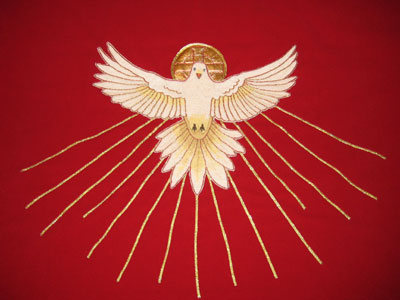
This first piece is a banner embroidered by Eileen Thompson. She worked the embroidery on linen first, and then cut it out and applied it to the red velvet background.

Eileen worked the dove in wool threads, in long and short stitch on the body, and fishbone stitch on the feathers. She used a metallic thread to outline the entire dove and all the wing details. Up close, the shading is a yellowy-cream color, but when viewed from far away, it blends into the white to look like the shadows that give definition to the shape of the dove. With church embroidery, this shading and outlining is important, because the pieces are meant to be seen from far away. The contrast between the white and the yellow and the contrast between the white and the outlines (in gold and red) are what make the details of the piece stand out from a distance.

Anne Gomes took a completely unique approach to creating this image for a Pentecost stole. She used the Bernini window at St. Peter’s Basilica in Rome as inspiration. Working on a ground of Japanese obi silk, she gold-leafed the fabric with combinations of real gold, real copper leaf, and real silver leaf. The dove is stitched in flat silk, with long and short stitch, and outlined with black flat silk.

You can see here a close up on the stitching and on the background, with the combination of the different gold leafing.
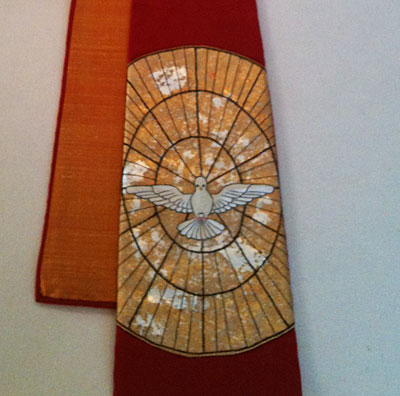
The stole was constructed from a brocade blend fabric, in Pentecost Red, and the lining of the stole is a red-gold silk dupioni.

Going back to the image of the Holy Ghost showing up in larger figure embroidery (“pictures” on vestments of old), here you can see the Holy Ghost depicted at the Annunciation on the back of this cope.
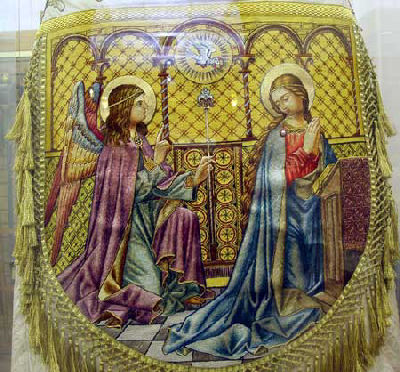
Though centrally located in the whole embroidered image, the dove might be easily overlooked – it is subtle, compared to the vivid colors of the embroidered figures.

Here again is a small image of the dove, hovering above a large image of God the Father on the back of this cope.
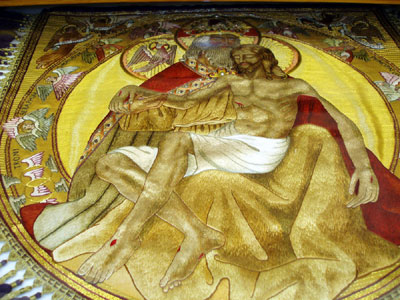
You can see the small dove over the right shoulder (left of the picture). Unfortunately, this piece was stored in a deep drawer, and this was the best angle at which I could get a full shot of the whole cope hood!

Up close, this embroidered dove looks fairly large. In fact, it is tiny, subtly present in the embroidery that adorns this chasuble:

Another photo of a piece in storage – the red circle on the left of the photo shows you where the dove figures into the overall embroidered image. Incidentally, the dove is only approximately 2″ high.

Here’s another little dove – again only a few inches in circumference. This one is located on the front panels that decorate another cope illustrating the Annunciation:

The red circle outlines the location of the above embroidered symbol in context with the rest of the embroidered panels.

Sometimes, doves figure into ecclesiastical embroidery as symbolic elements, without necessarily representing the Holy Ghost. Here, for example, is a dove held on the hand of an embroidered saint. How to distinguish this as a symbol of peace and purity in general (in association with the particular saint), or a symbol of the Holy Ghost? Notice the lack of the nimbus or halo around the bird. If the bird were meant to represent God, the artists designing and embroidering the piece would have certainly surrounded the dove with some kind of representative halo. The more elaborate the halo, in fact, the “higher the rank” in ecclesiastical symbolism. So the saint has a halo, but the dove doesn’t – it is not meant to represent the Holy Ghost in this particular image.
So there’s a little glimpse of some of the symbolic elements of church embroidery! Thanks to Anne and Eileen for the inspiration & the pictures of their pieces!